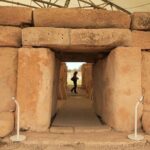

The Ħal Saflieni Hypogeum is the world’s only known prehistoric underground temple — 6,000 years old, carved entirely by hand, resting place of around 7,000 people. Only 80 visitors per day are allowed in. Book months ahead via Heritage Malta (€35), or queue at Fort St. Elmo at 9am for a €50 last-minute ticket for the following day. No photography. No flip-flops. No children under 6. And yes, the science on what happens to your brain in the Oracle Room is genuinely strange.
The only prehistoric underground temple on Earth
I’ve been taking people around Malta’s ancient sites since before some of them had proper visitor centres, and the Hypogeum is still the one that stops people mid-sentence. Not the most visually dramatic thing on the island — not at first. It takes about ninety seconds underground before the scale of it lands, and when it does, it’s quiet in a way that Ħaġar Qim in open air never is.
⟵ Scroll table on mobile
| Location | Paola (Raħal Ġdid), ~3km south of Valletta |
| Date | 3300–3000 BC — older than the Egyptian pyramids and Stonehenge |
| What it is | Three-level underground necropolis and ritual complex, carved entirely by hand |
| Size | ~500m² across three levels; deepest point 10.6m below street level |
| Bodies buried | Estimated 7,000 people over ~1,000 years |
| UNESCO status | World Heritage Site since 1980 |
| Daily visitors | 80 maximum (10 per tour, 8 tours per day) |
| Why it’s unique | No equivalent structure exists anywhere else on Earth |
Other ancient cultures built burial mounds, cave tombs, catacombs. Nobody else carved a three-level complex of interconnecting halls, chambers, and ritual spaces entirely by hand into limestone, painted the ceilings in red ochre spirals, and built the acoustics so that a single bass voice vibrates every room at once.
The three levels
Everything is cut into globigerina limestone — the same warm, honey-coloured stone in Malta’s old buildings. Soft enough to carve with stone tools; stable enough to hold a three-storey underground structure for six millennia. An estimated 2,000 tonnes of stone was removed in total, hoisted to the surface by hand.
| Level | Depth | What’s here | Access |
|---|---|---|---|
| Upper | ~1m below street | Oldest section; some chambers began as natural caves. Early burials. Damaged in 1902 before excavation began. | ✓ Visitors |
| Middle | ~4–7m below street | Oracle Room, Main Chamber, Decorated Room, Holy of Holies. Architecture mirrors above-ground temples. | ✓ Visitors |
| Lower | ~10.6m below street | Water management, storage, mass burials. Sealed. | ✗ Closed |
Tools used: zero metal. Only chert, flint, obsidian, and antlers. Lighting was brought-in torches, removed after use — there are no torch niches or charcoal deposits anywhere in the site.
The Oracle Room
An oblong chamber on the middle level, the Oracle Room has been the subject of more formal acoustic research than probably any comparable prehistoric space. The ceiling carries red ochre spirals and honeycombs — among the oldest surviving painted surfaces in Europe.
Speak in a low voice inside this room and the sound fills the entire Hypogeum at once — floors, walls, ceilings — with an echo that hangs for several seconds after you stop. Heritage Malta’s Science Officer Joseph Farrugia described it simply: any deep word spoken there carries throughout the entire underground structure.
Researchers from the University of Trieste measured the room’s resonant frequencies at 70Hz and 114Hz — the range of a low male baritone. A shamanic drum hits the same frequencies; a conch shell produces nothing at all. A 2008 UCLA study found that exposure to 110Hz causes measurable shifts in brain activity: language processing drops, and the prefrontal cortex shifts from left (analytical) to right (emotional) dominance. A 2020 paper went further, showing that producing the Hypogeum’s full frequency spectrum required fine-tuning walls across multiple independent chambers simultaneously — not an accident. The peak frequencies form a whole-tone musical scale. Three studies on this are detailed below.
The acoustics were noticed almost immediately after the site opened in 1908. Writing in National Geographic in 1920, William Arthur Griffiths noted that any word spoken into the Oracle Room was “magnified a hundred-fold and audible throughout the entire underground structure” — and pointed out a curved carved projection on the back wall that acts as a deliberate sounding board.
The Holy of Holies
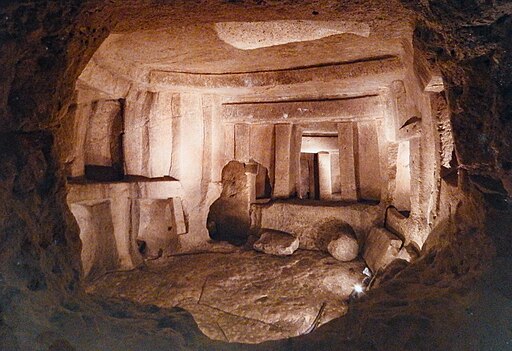
The tour ends here. The Holy of Holies is carved to look like the façade of a megalithic temple — the same trilithon architecture you’d find above ground at Ħaġar Qim — but cut entirely from negative space into the rock. You’re more than 7 metres underground. Half the tour group fits on the viewing platform at a time, so people take turns.
The corbelled ceiling — successive stone layers stepping inward, each oversailing the one below — is the best surviving clue to how Malta’s above-ground temples may once have been roofed. Those roofs have all gone. This one hasn’t.
No bones were found here. No offerings. The room wasn’t used for burial. The original above-ground entrance to the Hypogeum faced the winter solstice — on the shortest day of the year, sunlight would have come through the entrance and hit this room directly.
The Sleeping Lady
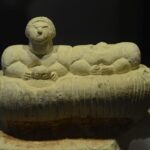
She’s not in the Hypogeum — she’s at the National Museum of Archaeology in Valletta, in her own darkened room. If you’re making the trip to the Hypogeum, go to the museum too.
| What she is | Clay figurine, 12cm long. A woman lying on her side on a couch, wearing a pleated skirt, bare-chested, head on a pillow |
| Where found | A pit near the Snake Pit chamber on the middle level — possibly a votive deposit repository |
| Dating | ca. 3600–2500 BC |
| Paint | Traces of red ochre |
| What she represents | Unknown. Museum label: “May represent death or eternal sleep” |
| UNESCO description | “One of the great masterpieces of prehistoric anthropomorphic representation” |
Three reclining figurines were found in the Hypogeum. Academic interpretations of what they depict include:
- Mother goddess / fertility figure — the most common popular interpretation
- Death or eternal sleep — based on burial context (Heritage Malta’s official position)
- Incubation sleep — a ritual practice in which a sleeper sought communication with the divine or the dead, documented across ancient Mediterranean cultures
The Sleeping Lady’s resting pit sits adjacent to a shaft descending toward the sealed third level. Some archaeologists read this as the site’s most sacred deposit point — not random placement.
The elongated skulls — and the ongoing science
When Zammit excavated in the early 1900s, some skulls showed pronounced cranial elongation — and that detail has been generating theories ever since. A 1920 National Geographic article described the early inhabitants of Malta as a long-skulled people with affinities to early Egyptian populations. Of an estimated 7,000 individuals buried here, fewer than 20 skulls survive. Six are at the National Museum of Archaeology; the others have been in reserve storage since 1985, accessible only by research permission.
- Medical study of the six surviving skulls confirmed thalassaemia intermedia in all specimens — a Mediterranean anaemia consistent with an island population under genetic pressure
- The elongated forms reflect a combination of natural dolichocephaly (a skull shape, not pathology) and, in some cases, deliberate cranial shaping in infancy — documented across multiple ancient cultures
- The “alien skull” interpretation has been formally debunked at the Hypogeum’s own visitor centre (2017)
- The more interesting open question: who these people actually were, and why their civilisation vanished around 2500 BC
Heritage Malta, the Superintendence of Cultural Heritage of Malta, and Macquarie University Sydney launched The Sentinels of Ħal Saflieni: Science Facts versus Science Fiction — the first-ever interdisciplinary analysis of the surviving remains. Scope:
- DNA ancestry profiling
- Isotope analysis (diet and mobility)
- Full osteological and medical pathology study
- Archaeological, historical and archival research
Results are expected to significantly advance understanding of who the temple builders of Malta actually were and their relationship to other Neolithic Mediterranean populations.
Discovery and history
| 1902 | Workers cutting cisterns for a housing development in Paola break through the roof. They try to conceal it. Houses are completed directly above before officials intervene — permanent damage to the upper level. |
| 1903–07 | Fr. Manuel Magri directs first excavations. Dies in Tunisia 1907 before publishing his report. The report is never found. |
| 1908–11 | Sir Themistocles Zammit takes over, excavates until 1911. Deposits finds at the National Museum of Archaeology, Valletta. Site opens to visitors while excavations continue. |
| 1980 | UNESCO World Heritage Site designation. |
| 1991–2000 | Closed for conservation. CO₂ and humidity from unlimited visitors had damaged the limestone walls and ochre paintings irreversibly. New microclimate controls and 80-person daily limit introduced. |
| 2016–2017 | Closed again for €1.1 million environmental upgrade (partly funded by Iceland, Norway, Liechtenstein). New climate control system, real-time microorganism monitoring, humidity buffer zones. Reopened May 2017. |
Every human body in the Hypogeum raises CO₂, temperature, and humidity. Pre-2000, thousands of visitors per year without limits caused visible deterioration of the ochre paintings. UNESCO commissioned a scientific study that set the current 80-person maximum as the ceiling for safe visitation. The photography ban, shoe covers, and locker policy all serve the same function: minimising environmental impact on a 6,000-year-old interior that cannot be restored if damaged.
Tickets — how to actually get in
Standard adult tickets are €35, sold via the Heritage Malta website. In peak season (roughly April–October), they sell out two to three months ahead. No waitlist exists — check regularly for cancellations.
⟵ Scroll table on mobile
| Option | Price | Where | When / notes |
|---|---|---|---|
| Advance online | €35 adult | heritagemalta.mt | Book as early as possible. Non-refundable, non-exchangeable. |
| Last-minute | €50 | Fort St. Elmo (Valletta) or Gozo Museum of Archaeology — until noon. After noon: National Museum of Archaeology, Domus Romana, or Hypogeum itself. |
Day before only. First-come, first-served. Max 4 tickets per person. Families of 5+ need ID for each member. |
Last-minute strategy that works: Fort St. Elmo opens at 9am; the Hypogeum doesn’t open until 10am. That one-hour head start matters — 20 last-minute spots per day, gone fast in peak season. In low season (winter), arriving at 7:30am may find you almost alone in the queue.
Tours: Groups of 10 · 8 tours per day · ~45–50 minutes underground · 20-minute AV presentation beforehand (available without a tour ticket).
Getting there
Address: Triq iċ-Ċimiterju, Paola (Raħal Ġdid) — about 5 minutes’ walk from Paola Parish Church, 3km south of Valletta. 📍 Google Maps
| By bus | Routes 81, 82, 83, 84, 88 from Valletta/Sliema. Stop “Ipogew” (for the site) or “Pjazza” (Paola centre). Both hop-on/hop-off bus tours stop one minute away on the Red South Route. |
| By car | No dedicated parking. White-marked street spaces in surrounding residential roads. Essentially impossible in summer — take the bus. Renting a car in Malta? Read this first. |
| Arrival | 15 minutes before your slot. Late arrivals are turned away without refund — multiple visitors have discovered this. |
Rules and logistics
| Shoes | Closed shoes only — enforced at the door, no refund. Plastic shoe covers given on entry. Surfaces are slippery. |
| Children | Under 6: not admitted. No exceptions. |
| Bags & phone | Everything in a locker before entry. Your phone stays locked away — not just silenced. |
| Photography | Strictly prohibited inside the archaeological site. AV room and surface display are fine. |
| Wheelchair | AV room and display area accessible. Archaeological site is not — steps, narrow passages, uneven surfaces. |
| Tall visitors | Low ceilings throughout. Over 6ft: you’ll be ducking constantly. |
| Claustrophobia | Tight with 10 people; narrow passages; low ceilings. Most mild sufferers manage fine — walkways are railed, you’re never stuck. Severe claustrophobia: think carefully before booking. |
| Temperature | Not cold — the microclimate is actively controlled. Visitors frequently remark on this. |
| Audio guide | Personal device, multiple languages. Need a written script instead? Request at least one week ahead. |
What the experience is actually like
People leave either floored or underwhelmed, and based on the reviews the difference usually comes down to how much they knew walking in.
The honest structure of the visit:
- 20-minute audiovisual presentation aboveground
- ~45–50 minutes underground on a raised metal walkway
- Lighting activates at each stop, then switches off behind you — no lingering, no backtracking
- Audio guide in your language; physical guide keeps the group together and points out things you’d miss in the low light
- Guide quality varies — some are genuinely passionate; some are not
Things that surprise people:
- The site is smaller than photographs suggest. Wide-angle lenses are deceptive — the Main Chamber with 10 people on a walkway is intimate, not monumental.
- You cannot try the acoustics yourself. Speaking is discouraged inside the site. You’ll hear about the Oracle Room resonance through the audio guide; you won’t get to test it. This catches people out — it comes up repeatedly in reviews from visitors who read about it beforehand.
- The tour moves at a fixed pace. If you’re at the back during the archway section, the light goes off before you’ve had a chance to look — see the tips section below.
People who’ve read something beforehand. The acoustics research, the question of why this civilisation vanished around 2500 BC, what the figurines might mean — the tour commentary covers it but doesn’t go deep. One visitor put it plainly: “I recommend doing a bit of research before your visit — it will make your limited time there much richer.”
The Hypogeum isn’t competing with Ħaġar Qim or Ġgantija — open air, free to wander, photographable. It’s a 45-minute controlled tour underground where you can’t take photos or speak freely. What makes it unlike anything else on Earth is the thing itself — the only intact prehistoric underground ritual space still standing, seen by fewer than 30,000 people a year. Whether that’s worth the planning is a fair question.
Tips that actually make a difference
- Get to the front of the group and stay there. The guide sweeps a torch across features as the audio commentary runs. At the archway section in particular, there’s a cavern underneath and to the left — if you’re at the back when the light goes off, you’ll miss it entirely. This is the most consistent practical complaint across recent visitor reviews.
- Read the acoustics section above before you go. The Oracle Room is more interesting if you already know about the brain scan results. Standing there thinking “nice echo” is a different experience than standing there thinking “this room was tuned to shut down language processing.”
- For last-minute tickets: Fort St. Elmo, not the Hypogeum. Fort St. Elmo opens at 9am; the Hypogeum opens at 10am. That hour matters. One visitor arrived at 7:30am in February and found themselves almost alone in the queue until 8:45am — everyone got tickets.
- Pair with Tarxien Temples the same morning. Ten minutes’ walk east, no booking required, photographable, free with the Heritage Malta multi-site pass. The above-ground trilithon architecture makes the Holy of Holies comparison click in a way words can’t. Hypogeum at 9am, Tarxien by 11am, bus back to Valletta before lunch.
- Coffee before or after: Bites and Beans. One street away from the entrance. Good coffee, homemade food. The Hypogeum has only a small gift shop — useful to know before you arrive hungry.
- The €50 last-minute price is annoying. A lot of visitors call it gouging, and you can see why. Heritage Malta says it reflects conservation costs. Either way: the €35 tickets are non-refundable, cancellations are rare, and the 20 last-minute spots are the only other route in.
- The waiting area is air-conditioned and comfortable. Arrive early and use the time to look at the surface display — better than standing outside in Maltese summer heat.
While you’re in the south
Most visitors come from Valletta, do the tour, and head straight back. The south has more going on than that. Everything below is within a short bus ride or taxi from Paola.
Tarxien Temples — 10 minutes’ walk east. 📍 Google Maps
Same Neolithic culture, same date range, above ground, freely walkable, photographable. No advance booking. Standing in front of the trilithon doorways at Tarxien makes the Holy of Holies make sense in a way no photograph manages. Free with the Heritage Malta multi-site pass. If the prehistoric temples interest you, Ġgantija on Gozo is the other essential stop.
Fgura Parish Church (Our Lady of Mount Carmel) — 5 minutes by car or bus. 📍 Google Maps
Almost nobody outside Malta knows this exists. Built in 1988 to a design by Victor Muscat Inglott, it looks nothing like any other Maltese church — no baroque façade, no traditional bell towers. The interior is a wide, light-flooded circular space under a coffered dome. Modernist, quiet, a bit disconcerting after a morning in a 6,000-year-old burial site. On Triq Hompesch, Fgura.
Hompesch Arch, Żabbar — 10 minutes from the Hypogeum. 📍 Google Maps
Malta’s only surviving triumphal arch, built in 1801. The people of Żabbar raised it to honour Grand Master Hompesch, who had given the village city status in 1797 — then Napoleon arrived in 1798, expelled Hompesch and the Knights, and the whole project stalled. It was finished three years later under British rule, armorial crest left blank. Five-minute stop on the road south.
The Three Cities — 15 minutes by bus or taxi. 📍 Google Maps
Vittoriosa, Senglea, and Cospicua sit across the Grand Harbour from Valletta. Far fewer tourists, tighter streets, older feel. The waterfront at Vittoriosa (Birgu) is a good lunch stop — decent seafood, harbour views, half the price of Valletta. Worth an afternoon if you haven’t been.
Marsascala — 20 minutes southeast by bus. 📍 Google Maps
A working fishing village, not polished for tourists. The seafront restaurants serve fish landed that morning at prices aimed at local customers. Good lunch option if you’re already in the south. The bay is calm and swimmable in summer, quiet enough in shoulder season that you don’t need a reservation.
Għar Dalam — 20 minutes south by bus. 📍 Google Maps
A cave containing animal bones dating back 500,000 years and human remains from Malta’s earliest known settlers — the same population that eventually built the Hypogeum. Rarely crowded, cheap to enter, and genuinely strange. If the question of who these people were interests you, this is where the physical evidence starts.
National Museum of Archaeology, Valletta — back in Valletta, but essential. 📍 Google Maps
Holds the Sleeping Lady in her own darkened room, the elongated skulls (now back on display in the Alien Headaches? The Hypogeum Skulls Enigma exhibition), all the grave goods, pottery, personal ornaments, and carved animals from the excavations, and a reconstructed burial chamber. If you care about Malta’s prehistory, the museum visit isn’t optional — it’s the second half of the same story.
The acoustics research — three studies
University of Trieste researchers set up microphones in the Oracle Room and tested it with a range of voices and instruments. Key findings:
- Oracle Room resonates at two frequencies: 70Hz and 114Hz — the range of a low male baritone
- Male voice at those frequencies triggers resonance throughout the entire Hypogeum
- Shamanic skin drum: strong response at 114Hz
- Female voice: no comparable resonance
- Conch shell and horn: no resonance at all
“With a male voice tuned to these frequencies it is possible to stimulate the resonance phenomenon throughout the hypogeum.”
Archaeologist Fernando Coimbra described standing in the chamber during testing: he felt the sound crossing his body at high speed, leaving a sensation of relaxation.
Dr. Ian Cook’s team at UCLA ran EEG brain scans on 30 volunteers while playing them tones from 90Hz to 130Hz. At 110Hz — the Oracle Room’s resonant range:
- Activity in the left temporal region (language centre) dropped significantly
- Prefrontal dominance shifted from left (analytical) to right (emotional)
- This pattern does not occur at other frequencies
“These findings are compatible with relative deactivation of language centers and a shift in prefrontal activity… related to emotional processing.”
The Oracle Room may have been tuned to switch off the critical mind and activate something else — what some researchers call the hypnagogic threshold, the edge of sleep where vivid mental imagery starts.
The most technically rigorous paper asked directly: was the frequency spectrum accidental?
- Producing the observed resonance required fine-tuning multiple non-contiguous walls across independent chambers simultaneously — the researchers say this cannot be coincidental
- The peak frequencies are evenly spaced and resemble a whole-tone musical scale — again, not random
- The paper places the Hypogeum among the earliest known examples of a built structure with a deliberately designed musical element
“The Oracle Chamber… appears to be intentionally carved into the form of a wave guide.” — Glenn Kreisberg, radio frequency engineer
Further reading — academic sources
Debertolis, P., Coimbra, F. & Eneix, L. (2015). Archaeoacoustic Analysis of the Ħal Saflieni Hypogeum in Malta. Proceedings of the OTS Foundation Conference on Archaeoacoustics. University of Malta Open Access Repository. Full PDF
Till, R. et al. (2020). The Frequency Spectrum and Geometry of the Ħal Saflieni Hypogeum Appear Tuned. Journal of Archaeological Science: Reports. Abstract — ResearchGate
Cook, I.A. et al. (2008). Ancient Architectural Acoustic Resonance Patterns and Regional Brain Activity. Time and Mind, Vol. 1(1), 95–104.
Devereux, P. (2009). A Ceiling Painting in the Ħal Saflieni Hypogeum as Acoustically-Related Imagery: A Preliminary Note. Time and Mind, Vol. 2(2), 225–231. Taylor & Francis.
Pace, A. (2004). The Ħal Saflieni Hypogeum. Heritage Books / Heritage Malta, Sta Venera.
Savona-Ventura, C. (2021). Ħal Saflieni Hypogeum — The Alien Skulls. Medical analysis of surviving skulls including thalassaemia diagnosis. Full paper — Academia.edu
Heritage Malta / Superintendence of Cultural Heritage / Macquarie University Sydney. The Sentinels of Ħal Saflieni, Malta: Science Facts versus Science Fiction. Interdisciplinary project, Union Académique Internationale grant, launched 2019.
UNESCO World Heritage Centre. Ħal Saflieni Hypogeum — Nomination Documentation and State of Conservation reports. whc.unesco.org
Frequently asked questions
How far in advance do I need to book?
Peak season (April–October): aim for two to three months ahead. Off-season: availability opens up, but February can still be fully booked weeks out online. Check Heritage Malta’s site regularly — cancellations do appear.
What if I can’t get advance tickets?
Last-minute tickets (€50) are sold the day before your visit. Fort St. Elmo in Valletta opens at 9am — an hour before the Hypogeum. After noon the same day, also try the National Museum of Archaeology, the Domus Romana, or the Hypogeum directly. These 20 daily spots go quickly in peak season; in winter you have a reasonable chance of getting one same-morning.
Can children visit?
Under 6: not admitted, no exceptions. Older children are fine — teenagers particularly seem to find it striking. The tour is 45 minutes and the pace is fixed; younger children with no interest in archaeology may struggle.
Why is photography banned?
CO₂, humidity, heat, and light all degrade the limestone walls and the 6,000-year-old ochre paintings. The 80-person daily limit exists for the same reason. This is conservation, not Instagram management, and it’s well-documented in the UNESCO State of Conservation reports.
Can I try the acoustics in the Oracle Room?
No. Speaking is discouraged to protect the site’s microclimate. You hear about the resonance through the audio guide; you don’t get to test it yourself. It comes up in a lot of reviews from people who’d read about it beforehand and expected to. The research section below explains what the studies actually found — worth reading before you go.
Is it wheelchair accessible?
Audiovisual room and display area: yes. The archaeological site: no — steps, narrow passages, and uneven surfaces throughout.
Is it worth €35?
The Heritage Malta multi-site pass — Tarxien, Ħaġar Qim, Ġgantija, the lot — costs €30. The Hypogeum is the most expensive single site by a wide margin. If prehistoric archaeology matters to you, nothing comparable exists on Earth and the price is a non-issue. If you’re mainly here for the sea and the baroque, 45 minutes underground with no photos and no chance to test the acoustics may not be worth three months of advance planning. One reviewer from Chicago said it plainly: compared to Ħaġar Qim, which you can wander and photograph in open air, the Hypogeum demands more and gives you something harder to describe. That’s either appealing or it isn’t.
What’s the difference between the Hypogeum and Tarxien?
Same Neolithic culture, same era, entirely different experience. Hypogeum: underground, tightly controlled, 45-minute tour, no photography, primarily a burial and ritual site. Tarxien: above ground, freely walkable, photographable, active ceremonial complex. Ten minutes apart. Do both on the same morning.
Can I watch the AV presentation without a tour ticket?
Yes — the 20-minute audiovisual presentation is available without booking the underground tour, requires no advance ticket, and is wheelchair accessible. Worth doing if you can’t get a tour slot.
Stay in Gżira near the promenade
A designer 2-bedroom apartment in Gżira, close to the church, around 2 minutes from the promenade, and near Manoel Island.
View on Airbnb