
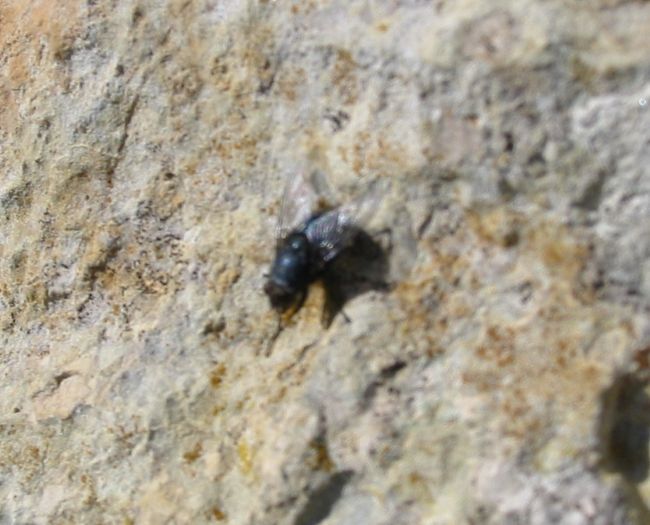

The Maltese Fly
I. Birth
The world arrives all at once—
compound eyes drinking light,
limestone walls, sun-bleached white,
already indifferent to this small accident.
Hunger is the first word known.
Fear is the second, carved in bone.
The sun pounds Malta’s stones to dust,
and in the shade where shutters rust,
wings unfold like whispered prayer:
small enough to vanish into air,
fast enough to stake a claim.
Every fly is born the same.
II. First Sprint
Flight is a miracle, three heartbeats long,
before it’s ordinary, before it turns to law.
The body’s law when terror takes the wheel,
when everything’s reduced to speed.
The air tastes sharp—of salt, of diesel fumes,
of rotting fruit and stairwell heat.
No plan. No future. No appeal.
Just the desperate spinning wheel
of milliseconds, wings, and fear.
Move or die. The rule is clear.
Eat or fade. Breed or disappear.
And somehow, in this church of panic’s call,
the fly finds time to rage against a wall—
offended, still, by windows sealed up tight.
The clock is running. The clock is never right.
III. Predators
The lizard on the courtyard stone
freezes, still as ancient bone,
tongue already mapping flight.
The sparrow tilts its head just right.
The spider hasn’t moved since dawn—
it knows what patience always buys.
Everything wants this protein dead,
this buzzing speck, this wing, this thread.
But stubbornness lives in the blood,
a defiance older than the flood:
the world is teeth and talon, claw and beak,
and still the fly refuses to be meek.
I am here.
I do not disappear.
IV. First Message
July heat, thick as syrup, thick as fate,
behind Ta’ Qali market, growing late,
between the bins and peaches left to rot,
something shifts. A tremor. Not a thought.
Not thought, exactly—flies don’t deal in those—
but certainty that through the bloodline flows:
This hunger feeds a larger need.
This panic plants a deeper seed.
Beneath the buzz, beneath the fear,
a carrier-wave begins to clear—
threaded through the swarm like ancient code,
passed in a smear of sweetness on the fruit,
a small, sticky gospel, half-remembered, mute,
too old to own, too vast to hold.
One day we become something more.
The fly can’t say what waits in store.
Only knows it’s written in the chain
of generations born to strain
toward a meaning none can name,
and yet they reach for it the same.
V. Adventure I: The Almost-Death
The horse’s tail swings like a scythe—
a wall of hair, alive, blithe,
moving faster than it has any right
for something so casual, so light.
Wind. Then darkness. Disaster’s smell.
Then: air again. The world’s still well.
Light again. Survival’s bell.
Luck—if that’s the honest word
for whatever force decides what’s heard,
what’s seen, what lives another hour,
what falls beneath the hoof’s dull power.
It lands one wing-width to the left.
The fly survives, relieved, bereft.
Later, clinging to a pipe,
it knows (not thinks—a fly just feels and goes):
Being hated doesn’t make you small.
Being hunted doesn’t mean you fall.
The world is violent without reason.
Cruelty doesn’t need a season.
VI. Epoch
Malta changes. Centuries slip.
Stone remains; the sounds just flip—
cart wheels fade to engine roar,
donkey bells to phone-screen glow,
voices layered—rise, then fade,
and somewhere low, the old men’s Maltese, carrying slow.
The harbor smells of fish and brine,
and now of sunscreen, chlorine, wine.
Generations live and die
in cracks no tourist passes by,
each one certain, each one proud,
the first fly ever scared of cloud.
But the island holds its ground.
The limestone drinks the sun without a sound.
And flies endure—the same old signal,
passed along, each body sure
it made the tune, each body gone
by afternoon.
The fly dies.
The fly remains.
Both facts run through the same old veins.
VII. Adventure II: The Feast
Saturday explodes in light—
the market’s mountains, pure delight:
a landscape built of scraps and shine,
of fish heads, fat, and crusted brine.
Pastizzi grease soaks through the print.
Melons crack. The honey slips
down wooden boards in golden strips.
The butcher sweeps aside his trimmings.
For one sweet hour, the fly is king—
a crown of crumbs, a made-up thing,
no clue what royalty might mean,
just full and fat and in between
the bliss of now and the coming fall.
But Sunday takes it. Sunday takes it all.
The vendors fold. The mountain dies.
The fly learns what the stone implies:
Abundance never stays for long.
Hunger hums the older song.
Everything will turn and churn.
Even joy must wait its turn.
VIII. Adventure III: The Giant World
The spray can hisses. Chemistry shifts.
The air turns strange. The poison drifts.
A shoe drops down without a thought.
A newspaper swings, a trap unsought.
A plastic bag floats through the port
like some transparent, drifting ghost.
The giants never see the web.
They call it “background,” watch it ebb.
They call it “pests.” They call it “grime.”
They call it “clean,” and close the door.
“She reaches for the spray and sighs.
“Just cleaning up,” she says.
The fly calls it weather.
Calls it learning how air shifts.
Same sun still burns. Same salt blows here.
Same breath the giants take at night
feeds the smallest speck in flight.
Even gods live downstream from something.
IX. Growing Awareness
The fly doesn’t plan. It doesn’t weigh.
But the bird that ate its kin today
fed its chicks. The chain held fast.
The scraps it cleaned would never last—
they’d breed disease beneath the heat
without the flies to break it down.
The nutrients it cycles through
feed the soil, and something new
grows to feed the ones who hate
the very fly that cleaned their plate.
I eat the rot.
I am the rot.
I am the turning of the plot.
Every role is mocked until
the role falls silent, and the still
air reminds the world what’s lost.
Worth is not about the cost
of being liked or being praised.
Worth is being what the web has raised.
X. Revelation
At the end, which comes on fast
(as endings do—they never last),
the fly rests on a sun-warmed stone
in Mdina’s court, ancient, alone.
This same limestone held the Knights,
the Romans’ feet, Phoenicians’ rites,
and older hands that left no names—
and now one fly, one fading spark,
resting in the afternoon’s soft dark.
The message finally comes clear—
not prophecy, not hope, not fear:
a looped transmission—nothing less.
The carrier-wave completes its arc.
“More” isn’t power. “More” isn’t size.
“More” isn’t winning someone’s prize.
“More” isn’t leaving the wheel behind.
“More” is this: the ties that bind
each generation to the last,
forgetting everything that passed,
and still—still—passing on the flame.
The panic is the engine’s name.
The hunger is the ticket paid.
The fly is small. The fly will fade.
The fly is also just one note
in a song no throat could ever quote,
a song that never learns to end.
Malta endures. The flies extend.
Not because they’re built to last—
because they let the moment pass
in service of what holds and bends
and breaks and heals and never ends.
Warm stone beneath. A shadow’s thread.
Bougainvillea—faint red flame.
The sweet, false smell of fruit somewhere.
The compound eyes close on the air.
The wings go still. The signal fades.
And somewhere in the shutter’s shades,
another fly wakes into light,
all hunger, eyes, and will to fight,
convinced the world has just begun—
which means the song is never done,
which means it always was, and is,
exactly, perfectly,
this.
For the island, and the small things that keep it.
John T — ManicMalta.com — Feb 2026
Stay in Gżira near the promenade
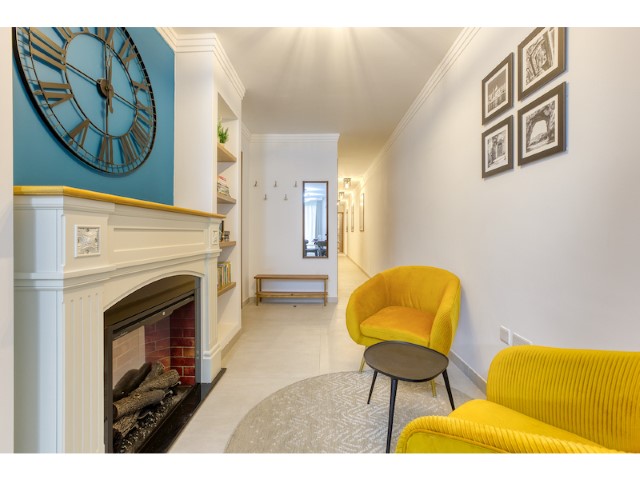
A designer 2-bedroom apartment in Gżira, close to the church, around 2 minutes from the promenade, and near Manoel Island.
View on Airbnb