
TL;DR – THE 30-SECOND VERSION
This is a 2026-specific visitor guide to Malta’s village festas: what a festa is, how the week works, which ones to prioritise, and how to survive the two things that surprise first-timers most: the noise and getting home after midnight.
If you only do one: Mosta (15 August 2026) for first-timers. If you want fireworks: Mqabba (15 August 2026; best on 14 August eve). If you want aerial fireworks: Hal Lija (6 August 2026). If you want church art plus procession impact without peak-August crush: Hal Qormi (28 June 2026).
Jump to:
Quick picks
What a festa is
How festa week works
2026 chronological table
Morning marches (Marc ta’ Filghodu)
Survival guide
Wearing festa colors
What to eat
Glossary
Etiquette
Photography
Plan B
Where to stay (Gzira)
You’re walking through a Maltese village on a Tuesday afternoon in July. Limestone streets empty. A cat crosses the road. A television murmurs behind a shutter. Nothing is happening.
Come back on Saturday night.
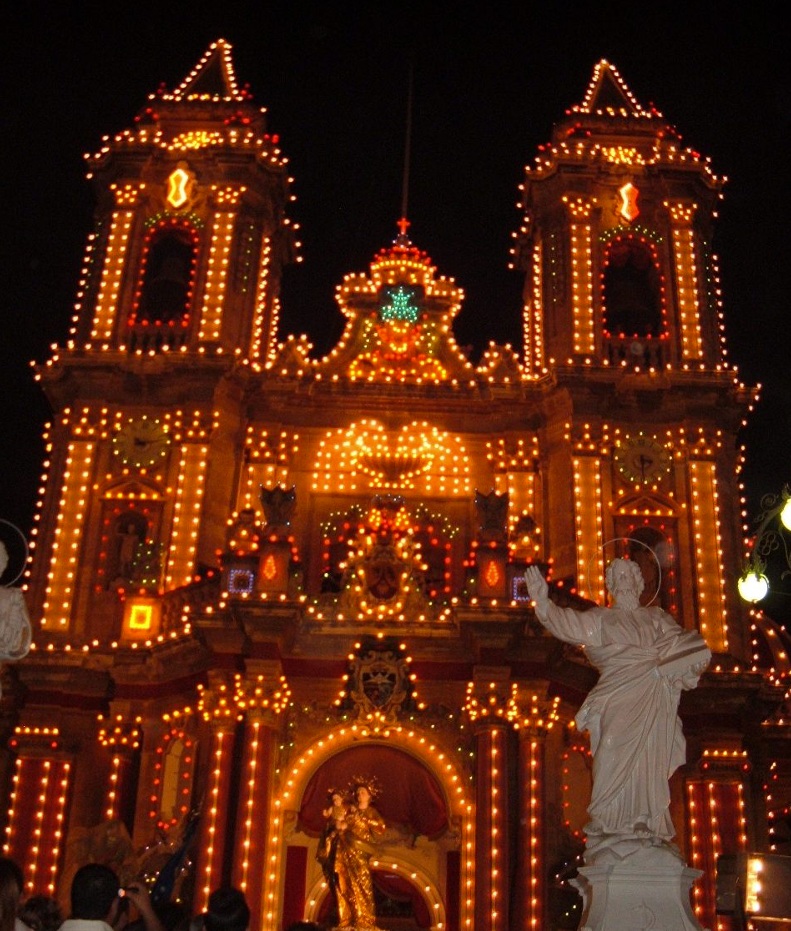
Those same streets will hold ten thousand people. Light bulbs will cover the church facade. Brass bands will march through gaps in the crowd that don’t seem wide enough for one person. The sky will explode. A wooden saint on velvet will emerge from the church on the shoulders of men who paid for the privilege of carrying it. Confetti will fall from balconies. Children will be awake at midnight. Nobody will be able to hear anything, and nobody will care.
This page is a curated shortlist, not the complete island directory. For a bigger master list of events and festivals (including village feasts across the year), use Events in Malta
Quick Picks (Skimmable)
If you have limited nights, this is the decision layer
- One festa, any summer: Mosta, 15 August 2026. Iconic dome backdrop. Best emotion: procession around 7:00pm. Best fireworks: 14 August (eve night).
- Fireworks nerds: Mqabba, 15 August 2026. The big expectation belongs to 14 August (eve). Note: Mqabba also has a separate feast, Our Lady of the Lily, 21 June 2026.
- Aerial fireworks: Hal Lija, 6 August 2026.
- Art/statue lovers: Hal Qormi (St George), 28 June 2026.
- Raw atmosphere: Zurrieq (Our Lady of Mount Carmel), 26 July 2026. Also a second Zurrieq feast: St Catherine, 6 September 2026.
- Close to Gzira without a car: Hamrun (St Cajetan), 9 August 2026.
- Morning-march fans: Zabbar’s Marc ta’ Filghodu is a classic “you feel it in your chest” experience. See Morning marches.
- If you hate crowds but still want one: Had-Dingli (Assumption), 23 August 2026 or Hal Safi (Conversion of St Paul), 30 August 2026.
What Exactly Is a Festa?
Not a festival in the usual “stages and wristbands” sense
A festa is a week-long celebration of a village’s patron saint (or Marian devotion) that fuses Catholic ritual, community rivalry, brass band culture, and pyrotechnics.
One sentence that matters: even when the street feels like a party, the core is religious; locals read the statue and church as sacred, not as props.
Why dates confuse visitors: the liturgical feast day (Church calendar) is often different from the parish festa date (the village’s big summer celebration, usually a Sunday). Fixed dates like 15 August and 8 September stay fixed; many others move to summer weekends.
For a liturgical calendar reference, see https://gcatholic.org/calendar/2026/MT-en.
Where to Stay for Festa Season: The Gzira Base
If you want central access and an easy return after midnight, base matters
Festas happen across the island, often with road closures and late-night transport friction. Staying central on the east coast makes everything easier: you can reach most localities by bus, and you are not gambling your entire night on a single return option.
Our recommendation: 3-bedroom apartment in Gzira
If you want a practical base for festa season (space, comfort, and an easier ride home), our 3-bedroom Gzira apartment is built for groups and families. Book on your preferred platform:
Why this base works: you are close to the main bus corridors, quick Bolt range for late returns, and you can reset properly after loud nights.

How Festa Week Actually Works
The rhythm that explains everything: eve night vs feast day
- Early week: banners go up, church interior gets dressed, band club nights start, lighter fireworks and petards appear.
- Mid-week: more marches, more noise, more stalls operating, village centre gets busier each evening.
- Eve night: Marc il-Kbir, the heaviest crowds, the biggest fireworks. If you only do one night, do this one.
- Feast day: morning mass and daytime noise, then the evening procession (often around 7:00pm) when the titular statue exits the church.
If you want a broader planning base beyond festas, start here: Travel Guide
and Travel Guide
2026 Festa Calendar (Top Picks, Chronological)
Fast planning table: date, feast, location, and why it matters
On mobile, swipe left to see full table details. This is a visitor shortlist; for a larger master list across the year, use
https://manicmalta.com/calendar-of-cultural-events-in-malta/.
| Date (2026) | Feast | Location | Description / why this one |
|---|---|---|---|
| 14 Jun | St Philip of Agira | Haz-Zebbug | Early season, historically resonant. For broader context, see Malta History Time Explorer |
| 21 Jun | Our Lady of the Lily | Mqabba | Separate Mqabba feast. Useful so visitors do not mis-time Santa Marija expectations. |
| 21 Jun | St Catherine | Zejtun | Big, authentic southern festa with a strong decorated core. |
| 28 Jun | St George | Hal Qormi (St George) | Complete first-timer festa: church, band energy, strong procession impact. |
| 26 Jul | Our Lady of Mount Carmel | Zurrieq | Raw atmosphere, rival energy, dense streets. |
| 06 Aug | Christ Our Saviour | Hal Lija | Aerial fireworks in a small-village setting. |
| 09 Aug | St Cajetan | Hamrun | Maximum intensity and crowd energy, close to the central coast. |
| 15 Aug | Assumption (Santa Marija) | Mosta | Best first-timer big-day pick: iconic Rotunda backdrop, strong all-round experience. |
| 15 Aug | Assumption (Santa Marija) | Mqabba | Fireworks pilgrimage; big expectation belongs to 14 August eve night. |
| 23 Aug | Assumption | Had-Dingli | Crowd-averse alternative that still feels local. |
| 30 Aug | Conversion of St Paul | Hal Safi | Smaller-locality pace: easier to absorb. |
| 30 Aug | Our Lady of Loreto | Ghajnsielem (Gozo) | Gozitan scale: calmer, still authentic. Gozo logistics: if you do not stay overnight, expect the return ferry to be a bottleneck after midnight. |
| 06 Sep | St Catherine | Zurrieq | Second Zurrieq feast; rival energy continues. |
| 08 Sep | Nativity of Our Lady | Various | Traditional closing of festa season (national date). |
Morning Marches (Marc ta’ Filghodu)
The underrated slot: bright sun, full band, fewer tourists, pure local energy
The Marc ta’ Filghodu is the morning march on feast day. It is louder than you expect for daylight, and it can be one of the most fun parts of the entire week: brass band at full volume, streets dressed, people still fresh, and the village feeling like it belongs to itself rather than to the night crowd.
Heat factor warning: morning marches in August can be brutal. Wear a hat, use high-SPF sunblock, and stay hydrated. The combination of beer, brass bands, and 35C heat in narrow limestone streets can be a lot.
Zabbar is the specific name visitors should remember here: Zabbar’s Marc ta’ Filghodu is the classic reference point locals mention when they mean “morning march done properly.”
Best Morning Marches (Visitor Shortlist)
- Zabbar – Marc ta’ Filghodu: the standout daytime slot people talk about for pure atmosphere.
- Mosta (Santa Marija, 15 August 2026): big feast day, big morning. If you’re already going for the evening procession, the morning march is a bonus layer.
- Hamrun (St Cajetan, 9 August 2026): daylight intensity for people who like the full sensory version.
- Hal Qormi (St George, 28 June 2026): major festa feel before August peak heat.
How to Survive Your First Festa
The practical stuff that decides whether the night is magic or misery
- Plan your return journey. Roads close; buses stop outside the core; frequency drops late. Do not assume you’ll improvise at 12:30am.
- Concrete pattern: walk 10 to 15 minutes out to a main road corridor rather than waiting inside the closed-off core.
- How to find the official programme: every village prints a small flyer and almost always posts a Programm tal-Festa online. Check the local Band Club Facebook pages (look for names like Tal-Ghaqda or Socjeta Filarmonika) for the minute-by-minute schedule.
- If you’re noise-sensitive: stand off the main square on a side street with line-of-sight; avoid positions near petards or right under bell towers.
- Ear protection for kids: proper ear defenders for small children; plugs for sensitive adults.
- Arrive early: the statue exit is the emotional peak, often around 7:15pm to 7:30pm. Aim for 6:30pm arrival.
- No flip-flops near ground fireworks. Sparks are real. Closed shoes only.
- Toilets: limited. Plan a bar stop early. Do not wait until the procession is mid-street.
- Bring cash: EUR 20 to 30 in small notes and coins.
- Pack smart: for summer nights, comfort beats style. Use as a baseline.
- Gozo bottleneck note: if you’re heading to Gozo for Ghajnsielem and you do not stay overnight, expect long queues for the return ferry after midnight.
Wearing Festa Colors
A simple upgrade that makes the night more fun
Most villages have strong festa colors and visible club identity during the week: scarves, flags, shirts, ribbons, balcony banners. If you wear the colors, you stop feeling like you’re just watching and you start feeling like you’re inside it.
- Easy move: buy a scarf or small flag from a street stand and wear it for the march.
- Typical vibe: it is often Blue vs Green or Red vs Blue depending on the village and band clubs.
- Example for visitors: in Zurrieq, the Mount Carmel side is commonly associated with blue. If you show up in the right color on the right night, strangers will smile at you more.
- If the village has two rival clubs and you do not know the split: go neutral and enjoy the spectacle.
What to Eat at a Festa
Do not pretend it is a health event
- Imqaret – deep-fried date pastries. Eat at least two.
- Pastizzi – ricotta or peas. If you want the deep dive, see
- Qubbajt (nougat) – sold from traditional stalls with antique scales.
For a broader food primer beyond festa stalls, see Food in Malta
Festa Glossary
A few words that make the whole thing click
Pavaljuni: large fabric banners stretched across streets in parish colors.
Ghaqda tal-Banda: the band club, the social HQ of the village.
Titular: the main processional statue of the patron saint (or Marian devotion).
Marc il-Kbir: the big eve-night march: maximum emotion, maximum density, maximum noise.
Marc ta’ Filghodu: the morning march on feast day.
Kaxxa Spanjola: sharp concussive petards that announce the festa.
Giggifogu: ground fireworks (mechanised spinning effects at close quarters).
Festa Etiquette: The Don’ts
- Do not walk through the middle of a marching band.
- Do not enter the church in swimwear or ultra-short shorts during mass. Cover shoulders and knees.
- Do not try to touch the statue.
- Do not push forward for ground fireworks photos.
- Do not treat cups and confetti like someone else’s problem.
Photography Tips
- Blue hour wins: shoot the church lights just after sunset.
- Tripods are unrealistic during Marc il-Kbir. Handheld, minimal kit.
- Pick two shots: one wide crowd scene and one tight detail, then put the camera down.
- Be respectful in church during services.
Plan B: Quieter Festas
Less crushed does not mean quiet – it means more breathable
- Had-Dingli – Assumption: 23 August 2026. Later-season Assumption with typically less compression than 15 August hotspots.
- Hal Safi – Conversion of St Paul: 30 August 2026. Smaller-locality pace: easier to absorb.
Sustainability: festas generate a lot of confetti and plastic waste. Use bins when you see them, and if bins are overflowing, take your cup back to the bar or stall rather than dropping it.
Last updated: February 2026.
Stay in Gżira near the promenade
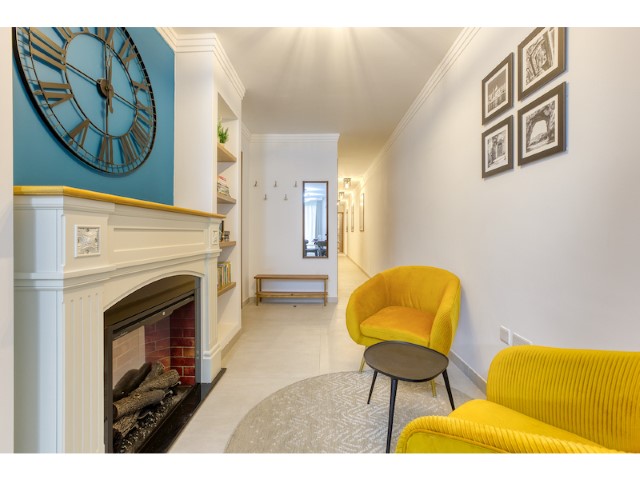
A designer 2-bedroom apartment in Gżira, close to the church, around 2 minutes from the promenade, and near Manoel Island.
View on Airbnb