
By J · 18 May 2026 · Heritage
TL;DR — THE 30-SECOND VERSION
For most people visiting Malta, Fort St Angelo is worth a morning. Plan on about 90 minutes inside, plus the time to get to Birgu and back. Heritage Malta runs the site, and the on-site interpretation is good enough that you walk away with a real chronology rather than a vague impression.
- Time inside: about 90 minutes for a normal visit. An hour is enough if you skim the interpretive panels; closer to two if you read them properly.
- Best for: people who like harbour views or military history, or who enjoy walking through old fortifications. The interpretation is bilingual Maltese and English.
- Less good for: small children who do not enjoy walking, visitors needing full step-free access, and anyone whose Malta trip is mainly about the beach.
- Best time to go: the first opening slot of the day. The light is better on the harbour side and the upper viewpoints are still quiet.
- Combines well with: a walk through Birgu’s collachio, lunch on the Vittoriosa waterfront, the Inquisitor’s Palace and the water taxi back to Valletta.
- Tickets and opening hours: change seasonally. Check Heritage Malta’s own page on the day rather than relying on numbers in a blog.
Jump to:
The short answer · What Fort St Angelo actually is · What it is like to walk in · What you see inside · The history, in walking order · Moments worth slowing for · If you get lucky — the costumed interpreters · Fort St Angelo vs Fort St Elmo · Tickets, time and getting there · Before you go — at a glance · FAQ
Is Fort St Angelo worth visiting? The short answer.
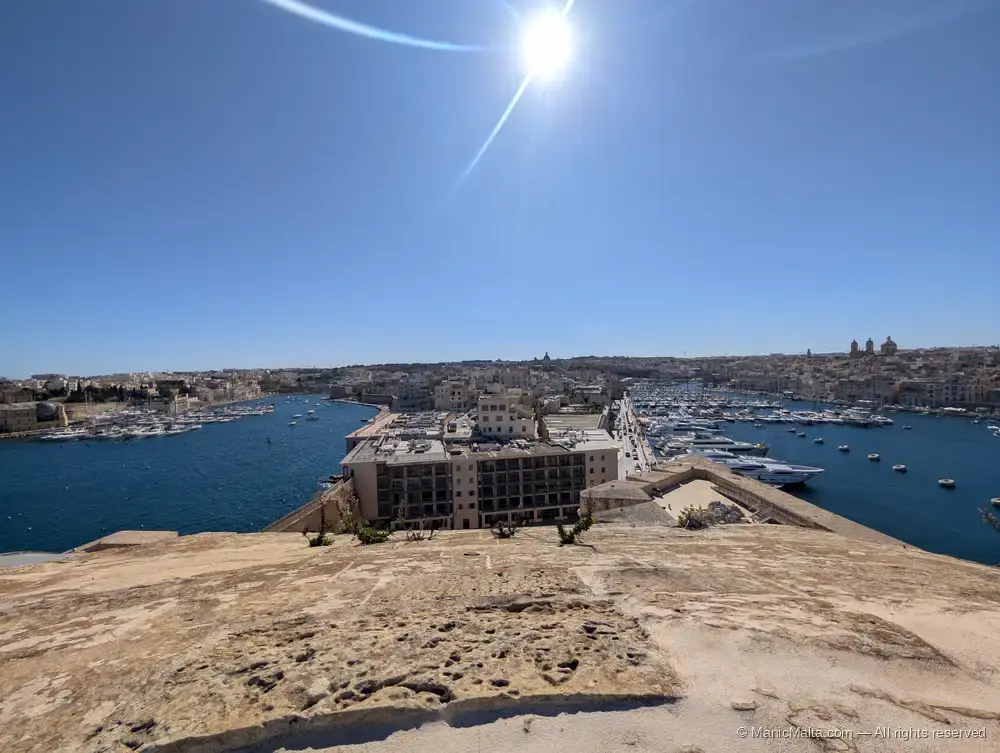
For most people visiting Malta, Fort St Angelo is worth a morning. Valletta’s bastions are larger and Fort St Elmo is the more famous siege site, but St Angelo has the longest continuous story on the harbour. The wider Birgu area has been occupied since the Phoenicians, and the headland itself has been fortified continuously from the medieval period onward. The building you walk through is what each occupant — Aragonese, Knights of St John, British Royal Navy, now Heritage Malta — built into and on top of what came before.
The site is mostly stone and slopes. If your Malta trip is built around the beach, or if you are taking children who do not want to walk, St Angelo will feel long. If you have any interest in how Malta was held and contested over four centuries, it is one of the better places on the island to see what that left behind.
The rest of this is what I wish I had read before going: what is inside, how long it takes, how it compares to Fort St Elmo across the harbour, and the practical points that decide whether you have a good visit or a hot, footsore one.
How we visited. Sunday morning in February 2026, in at opening and out a little under two hours later. Quiet for the first hour, then fuller from about ten when the cruise-ship and water-taxi groups from Valletta start arriving. The photos here are from that morning.
What Fort St Angelo actually is
Fort St Angelo sits at the tip of the Birgu peninsula on the south side of the Grand Harbour, directly opposite Valletta. “Fort St Angelo” in modern usage refers to the upper fort and bastions that Heritage Malta manages as a visitor site; the lower levels of the headland are still partly occupied, including private residences below the visitor route. The British Royal Navy continued to use parts of the complex well into the twentieth century — our dedicated post on HMS Egmont covers that British naval century in detail, and the pillar piece on the fort’s full history sets the wider chronology out.
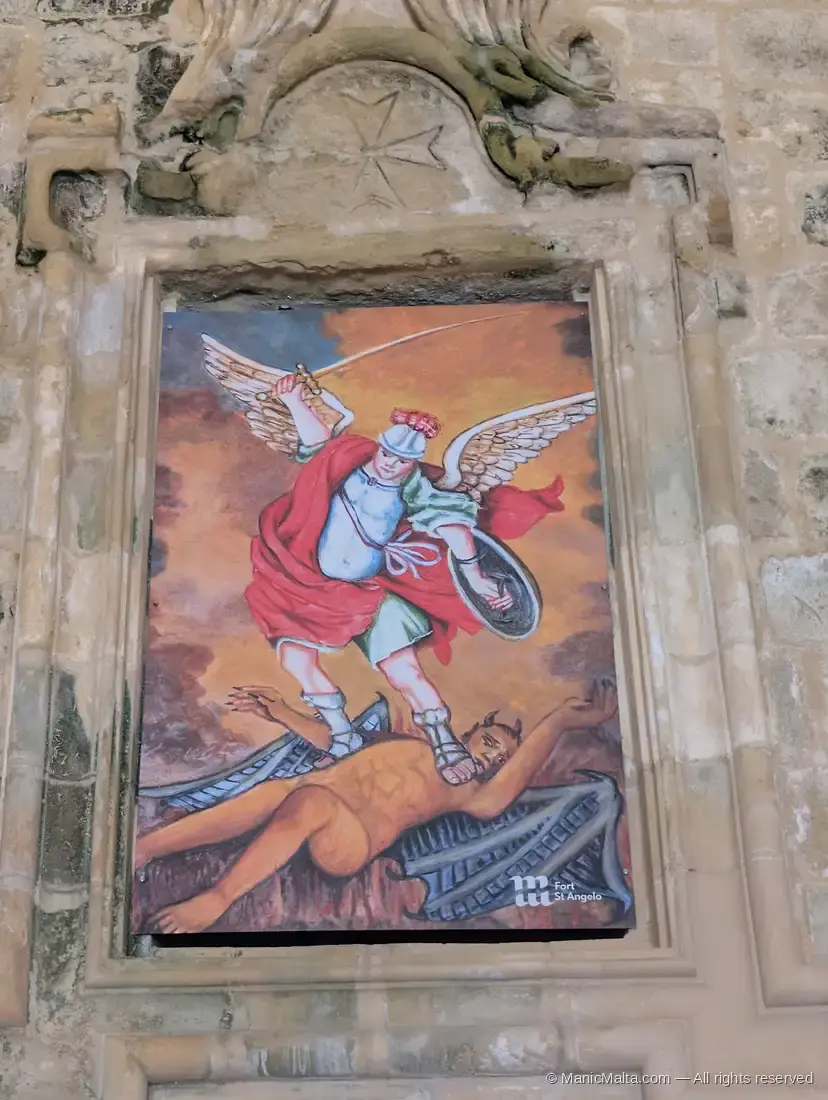
The name in Maltese is Sant’Anġlu — “the Holy Angel”, traditionally identified with the Archangel Michael, though the original medieval dedication is not unambiguous in the documentary record. You meet Michael almost as soon as you walk in. A painted panel of Michael standing over a fallen Lucifer sits above the inner gate, with the eight-pointed Maltese Cross carved into the stone surround. Most of the visitor route is built around the Knights of St John, who held the fort from 1530 until Napoleon arrived in 1798.
The medieval stronghold predates the Knights by centuries. The headland was already fortified as the Castrum Maris in the late medieval period — under Norman, Swabian, Angevin and then Aragonese rule — and there is earlier Phoenician and Carthaginian activity documented across the wider Birgu area. Our piece on the evolution of Castrum Maris covers the pre-1530 story properly.
What it is like to walk in
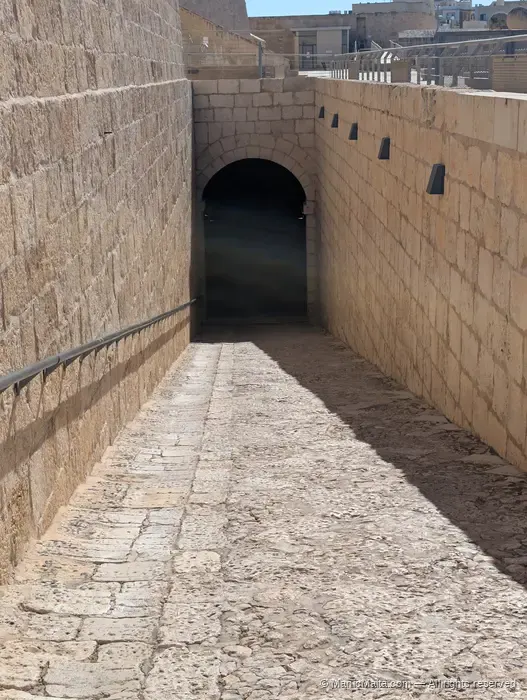
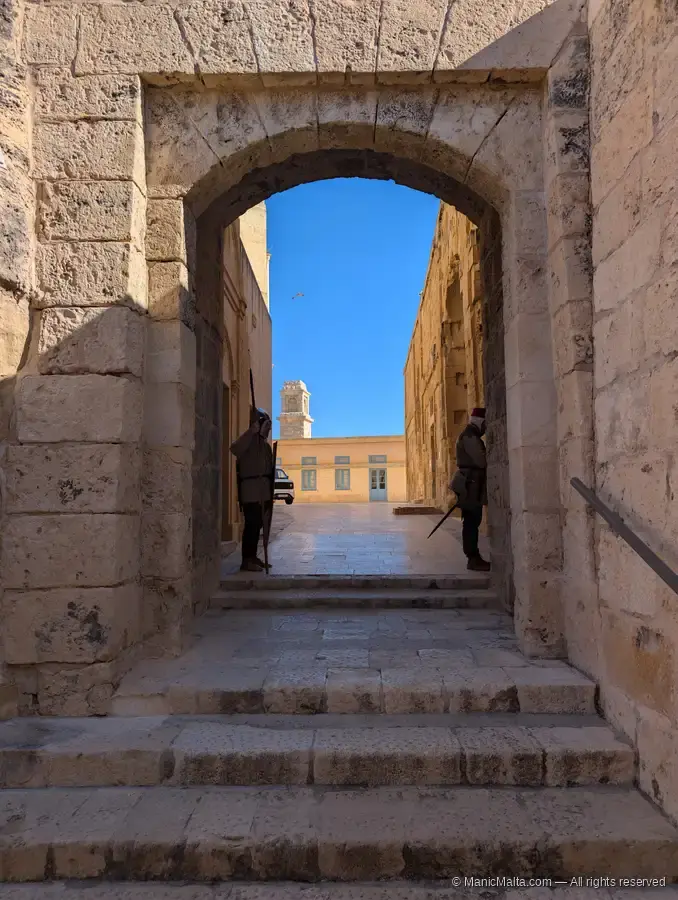
The visitor entrance is on the seaward side of the fort, reached on foot from Birgu’s waterfront. The approach is a sloping cobbled ramp running between two stone walls, narrowing into a low vaulted tunnel cut through the bastion. There is a short climb at the start; not difficult, but worth flagging.
The ramps are steep, the cobbles are uneven, and short stair sections turn up at intervals through the upper levels. Walking shoes matter; sandals do not work well here. Visitors using a stick or a frame will manage the lower courtyards and at least one harbour viewpoint, but the cavalier and the upper bastion are difficult. Wheelchair users should contact Heritage Malta in advance to confirm which sections will be usable on the day.
Inside the tunnel you meet the Archangel Michael painting above the doorway. The interior beyond it has not been over-restored: the stonework is original, the floor has dust on it. The painting itself is modern, but commissioned to echo the medieval dedication of the fort rather than as a museum-shop graphic. From there the route opens out into the lower courtyards.
What you see inside
The visitor route runs through the architecture, the interpretive panels and the views over the harbour at the same time. You can read a panel about the 1565 siege while standing on the bastions it describes.
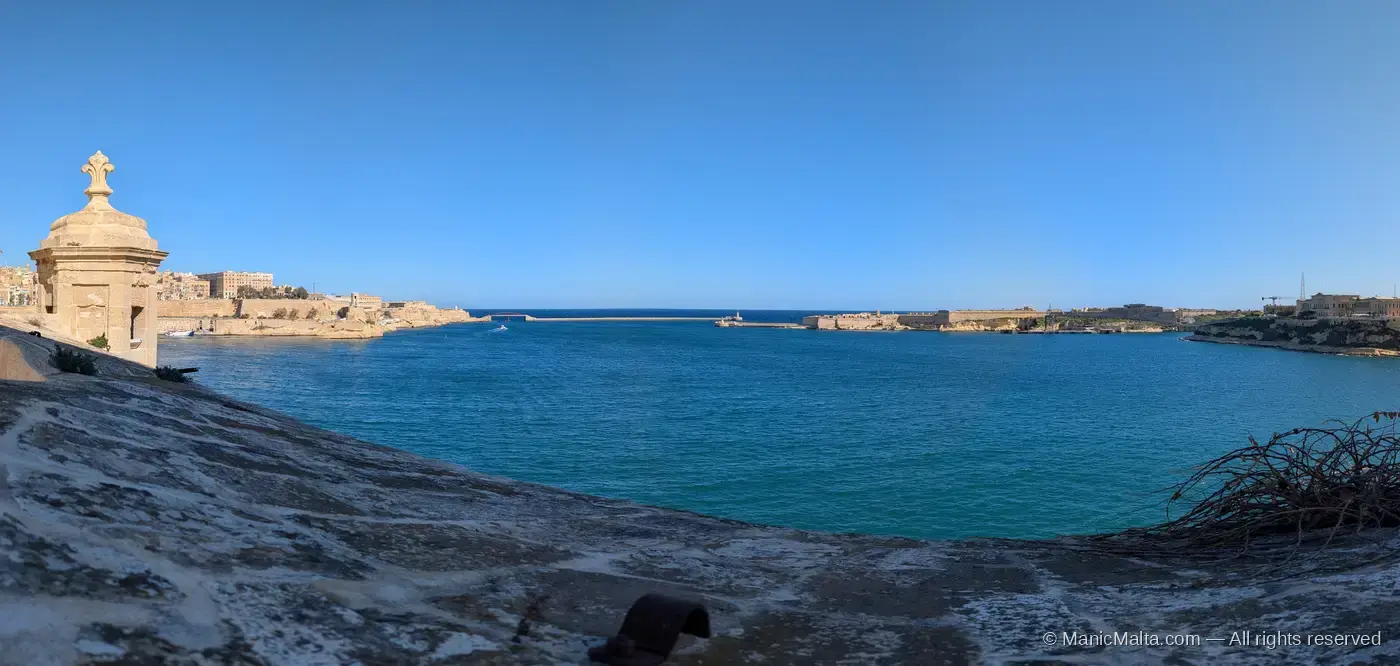
The harbour-side bastion is where the geography starts to click. On the corner sits a small stone Vedette, one of several lookouts around the harbour bastions; the more famous one with the carved eye, ear and crane is across the water at Senglea. In front of it the Grand Harbour opens up: breakwater and harbour mouth to the left, Valletta straight across, open sea further out. Anything coming in from the south by sea has had to pass through that gap, in cannon range, since the sixteenth century.
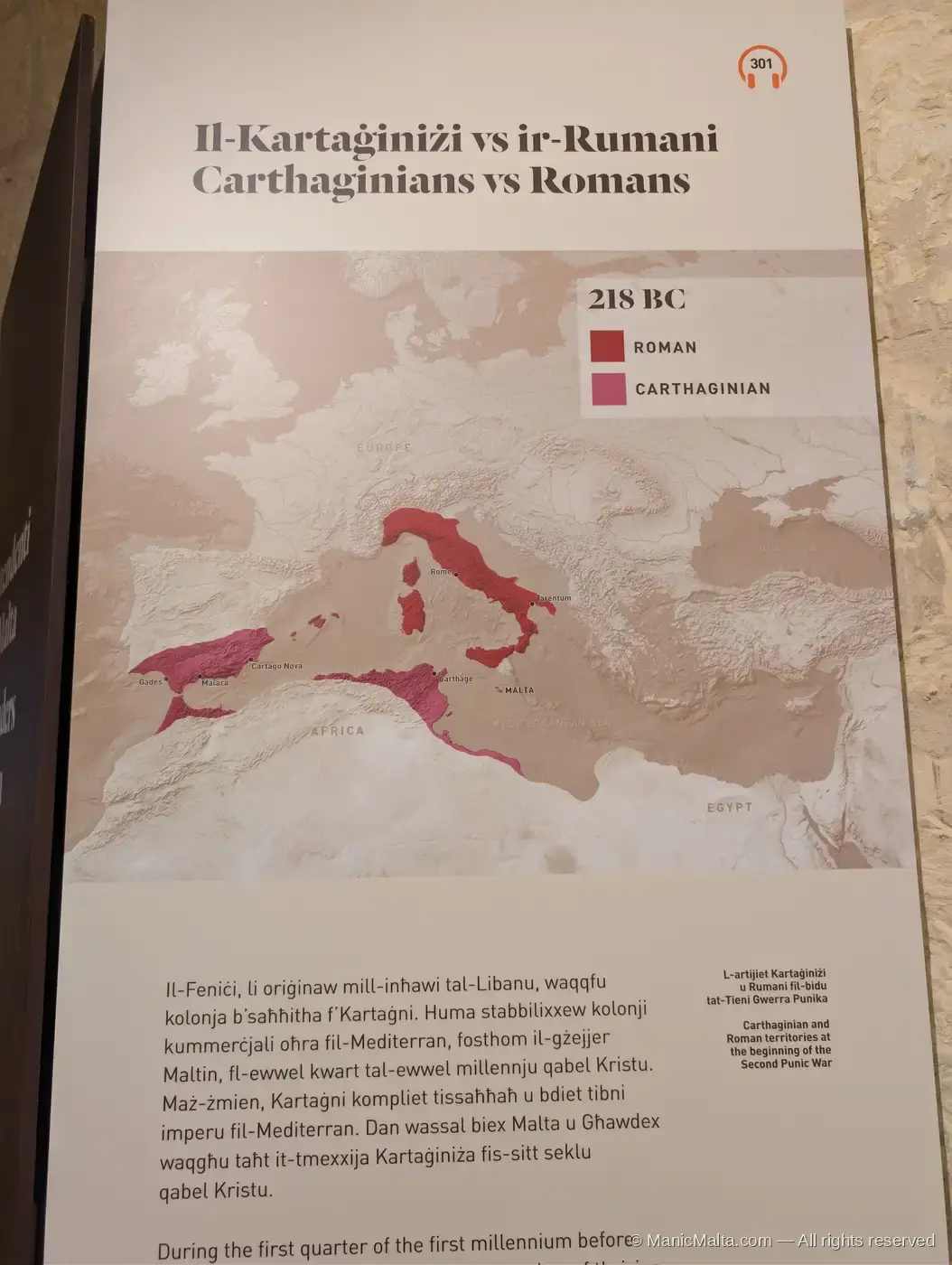
Interpretive panels are placed along the route in a numbered sequence; the antiquity section begins around panel 300. They are bilingual in Maltese and English, with maps and timelines rather than text-only blocks. Read four or five of them in sequence and the chronology of the central Mediterranean comes out in rough order: Phoenician, Punic, Roman, Byzantine, Arab, Norman, late medieval, Hospitaller, French, British.
The upper levels are mostly stonework: chapels, chambers, a long ramped passage that climbs to the cavalier. The architecture does most of the talking once you are inside. Walls eight to ten metres thick in places, deeply angled window slits, large underground cisterns. The building does not need a panel beside it to explain what it was built to survive.
The history, in walking order
The route is loosely chronological, which is uncommon in fort museums; most run on themed rooms instead. Here you walk forward in time as you walk through the building.
Early panels cover Malta’s Phoenician and Carthaginian phases: a Levantine trading colony established in the first quarter of the first millennium BC, absorbed into the Carthaginian sphere from the sixth century, and taken by Rome at the start of the Second Punic War in 218 BC. There is no surviving Phoenician masonry inside the fort, but the panels draw on the wider Birgu archaeology to make the case for continuous occupation of the headland.
The medieval section covers the Castrum Maris and the centuries between Roman Malta and the arrival of the Knights — Byzantine, Arab, Norman, Swabian, Angevin and Aragonese rule — then opens out into a longer treatment of the Knights of St John. The 1565 Great Siege fought across the harbour, the fort’s role in the defence, and the bastioned-fortress upgrades that followed are all covered. Our piece on Birgu in the Great Siege goes into that period in more depth.
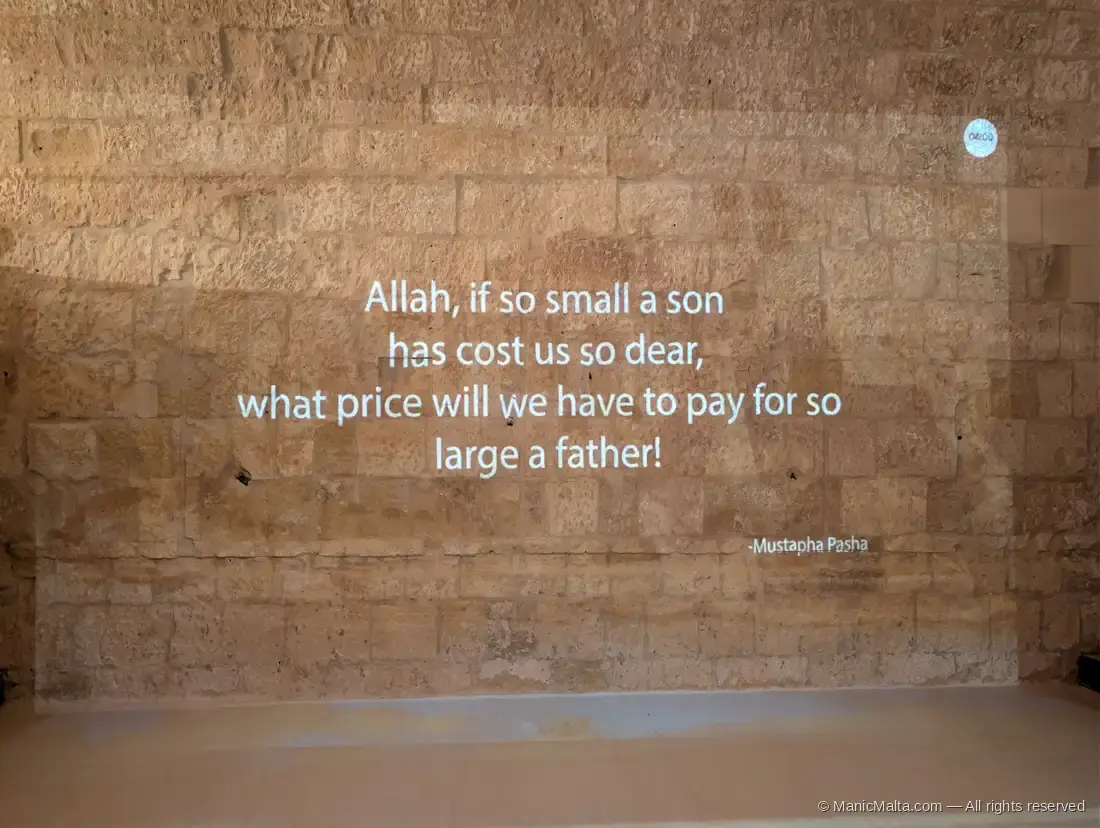
One of the chambers in the 1565 section uses a wall projection rather than a panel. It carries a line attributed to Mustapha Pasha, the Ottoman commander, after his forces had taken Fort St Elmo at heavy cost in the opening weeks of the siege:
“Allah, if so small a son has cost us so dear, what price will we have to pay for so large a father!”
— attributed to Mustapha Pasha, June 1565
The “son” is St Elmo, just taken. The “father” is St Angelo, across the harbour, the next objective. The siege continued for another two and a half months before the Gran Soccorso — the Christian relief force from Sicily under Don García de Toledo — landed at Mellieħa on 7 September 1565 and forced the Ottoman withdrawal. That date, 8 September, is still commemorated in Malta as Il-Vitorja, Victory Day.
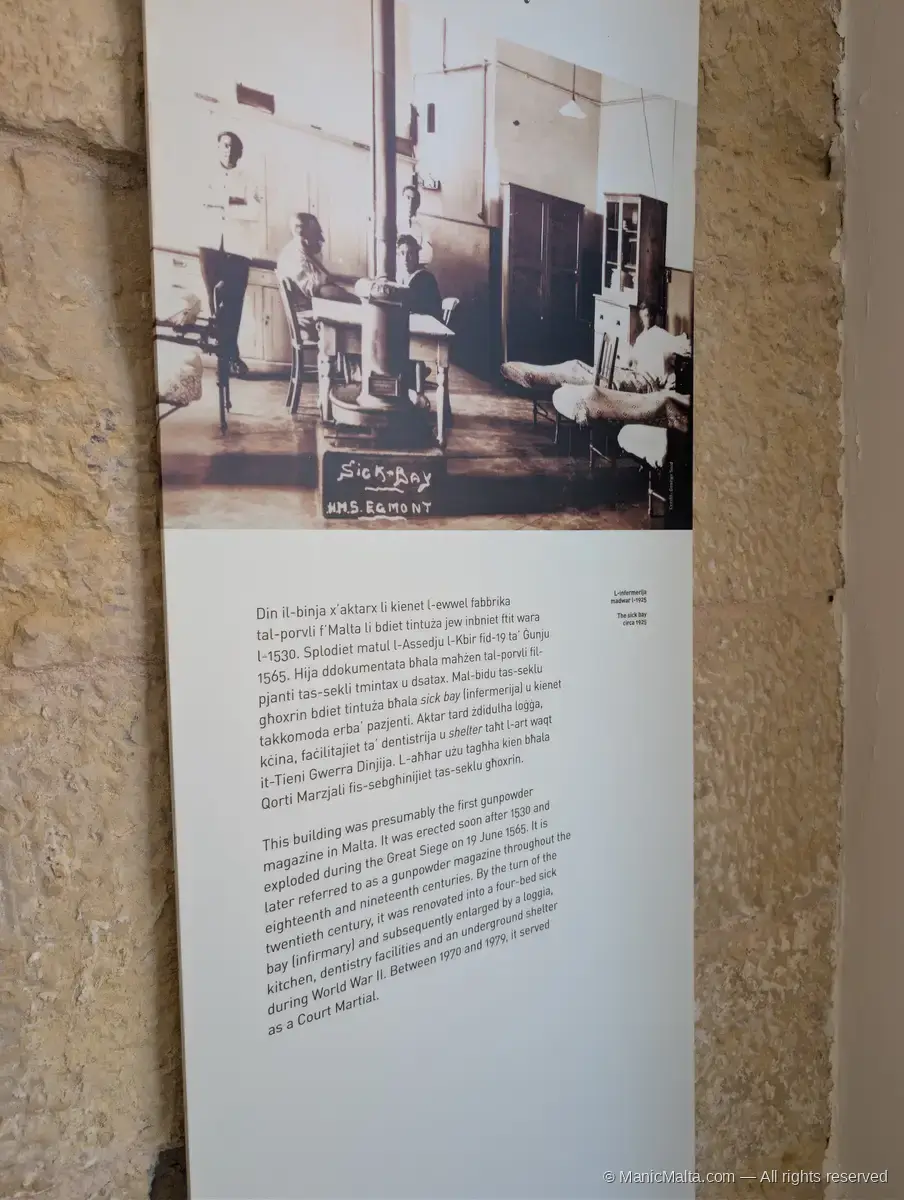
The British era is the part of the story most visitors are surprised by. After Napoleon’s brief takeover and the British Protectorate of 1800, Fort St Angelo became a Royal Navy shore establishment, commissioned as the “stone frigate” HMS Egmont and renamed HMS St Angelo in 1933. A four-bed sick bay, a dentistry facility, an underground air-raid shelter and the Court Martial venue all operated inside the same walls the Knights had built. (For the full British naval story, see our HMS Egmont post.) The interpretive panel for that chamber sets out the dates: gunpowder magazine through the eighteenth and nineteenth centuries, naval sick bay from the turn of the twentieth, enlarged during the Second World War, and used as a Court Martial venue from 1939 to 1979. Our piece on life in Malta during the First World War gives the wider naval context for that period.
The visit ends on the post-British handover and the site’s current life under Heritage Malta. A short closing stretch, but it covers the transition from working fort to museum without papering over it.
Moments worth slowing for
A few specific spots inside the fort reward a few extra minutes.
The first view from the harbour-side bastion. The first time you come out of the entry tunnel and the Vedette and the Grand Harbour land in front of you together. A wide-angle lens or a phone panorama does the job. In summer go for the hour after sunrise or before sunset; in winter, morning is fine.
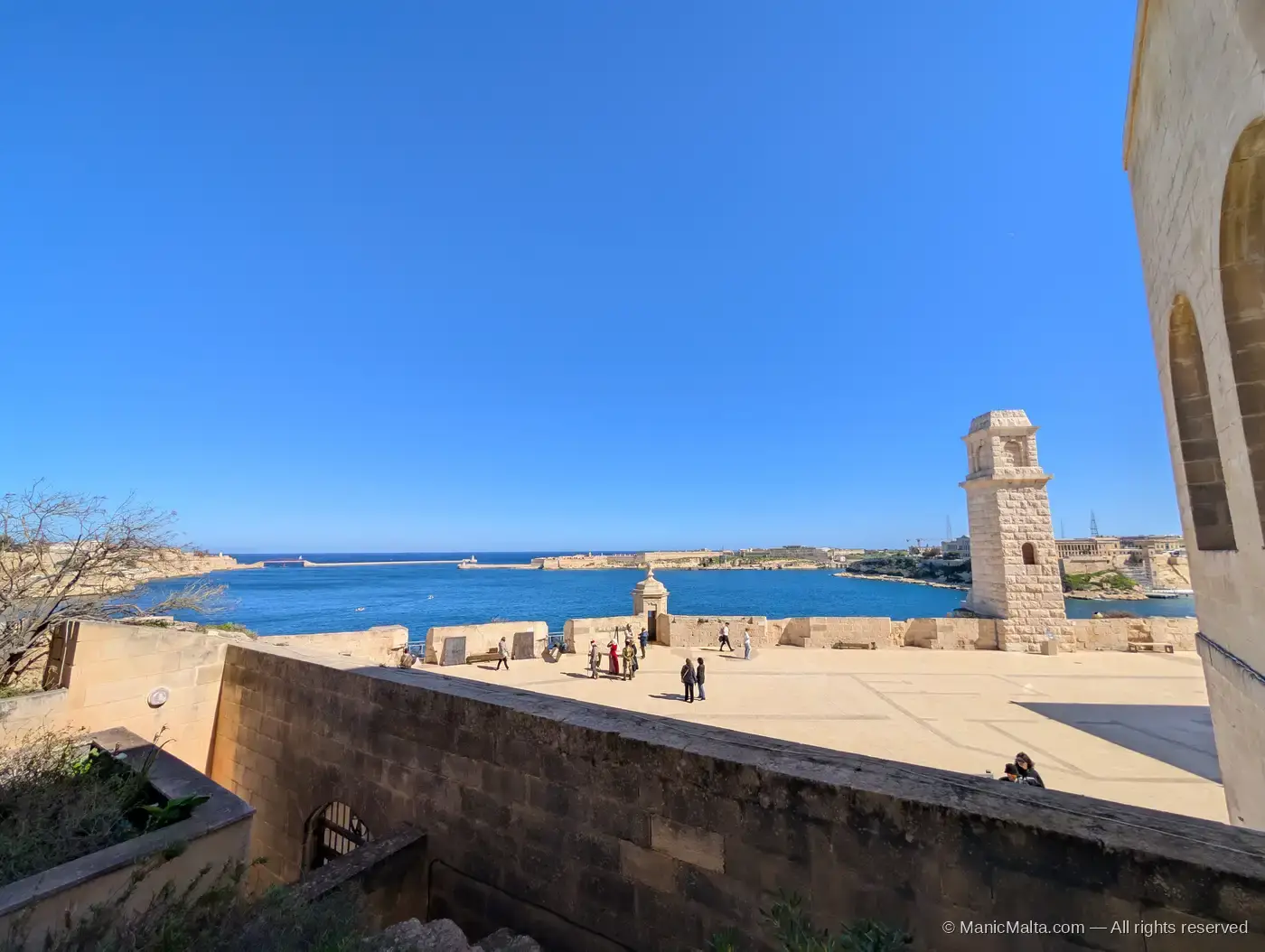
The cavalier — the upper platform. A long sloping ramp climbs to the highest accessible point in the fort. From the cavalier the whole sweep of the harbour is in one view: Senglea’s marina directly below, Valletta across the water, the breakwater and harbour entrance to the left. From the cavalier the Knights watched the central Mediterranean for two and a half centuries; it is still the best single viewpoint over the harbour. For photography specifically — including the bell tower and the seaward parapets — see our companion post on the best views from Fort St Angelo. The wider Three Cities defensive geometry is covered in our piece on Bormla’s fortifications.
The HMS Egmont sick bay. A small interior chamber, easy to walk past. The panel beside it documents one of the more compressed timelines on the site: gunpowder magazine, naval sick bay, dentistry, WWII shelter, Court Martial venue, all under the same roof. Worth a minute, and a photograph of the panel for reference later. The full story of that chamber and the wider British naval era is in our dedicated post on HMS Egmont at Fort St Angelo.
The long-exposure view towards the breakwater. One of the harbour-facing parapets gives a clear view down the line of the Grand Harbour breakwater out to the open sea, with the small steel-arch bridge visible above it. A boat passing through leaves a foam streak. Most phone long-exposure modes will hold it.
If you get lucky — the costumed interpreters
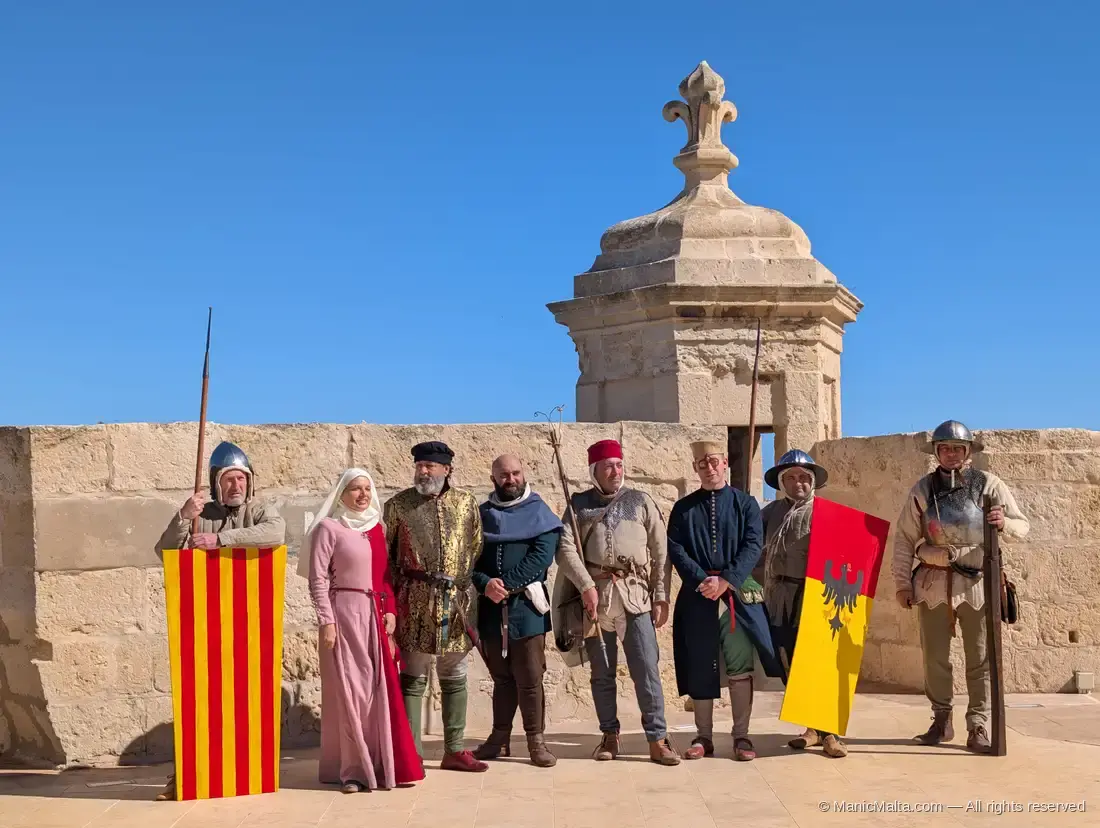
Some weekends Heritage Malta runs costumed historical interpretation on the upper bastions. It is not the full In Guardia parade scheduled at Fort St Elmo. The St Angelo version is a smaller, more contained display. On our visit a group of interpreters in mixed Knights-era dress was working on the bastion near the inner Vedette: a pikeman with a long spear, a swordsman with a striped heraldic shield, a noblewoman in a hennin headdress, an Ottoman-style figure in a red cap.
The schedule is not fixed, and the interpretation is not the main reason to come, but it adds something the panels alone do not give: scale. An empty cannon on an empty bastion is just an object. With a costumed gunner working beside it, the rest of the bastion suddenly has a function again.
Heritage Malta publishes the event calendar on its own site. If your dates are flexible, check whether a costumed-interpretation day falls within your trip before fixing the visit.
Fort St Angelo vs Fort St Elmo — which one?
The two forts are different visits, not duplicates of one another. If you have the time, do them on separate days. If you have to pick one, the choice has more to do with what kind of museum-visitor you are than with which fort is “better”.
Fort St Elmo sits at the tip of the Valletta peninsula, looking out to open sea. Its big moment is the 1565 Great Siege: St Elmo was the fort the Ottoman forces took first, at heavy cost, before the wider defence stopped them. The site now houses the National War Museum, so the visit is artefact-heavy. Our piece on the Fort St Elmo visit covers it in more detail.
Fort St Angelo is across the harbour on the Birgu side. The visit there is more about the architecture and the place itself than the exhibits. Interpretation is panel-based rather than display-case-based, and the harbour views look inward into the Grand Harbour instead of out to sea.
For visitors with time for both, the workable split is St Angelo in the morning and St Elmo on a separate day, with the Birgu collachio walk and the Inquisitor’s Palace folded in around the St Angelo trip. Doing both forts in a single day is possible in winter; in summer the combination involves more walking and more heat than most people will want.
Tickets, time and getting there
Tickets. Fort St Angelo is run by Heritage Malta and tickets are sold through their site and at the gate. Prices change with the season, and there are concessions for children, students and seniors, plus combined tickets that bundle several Heritage Malta sites. Rather than quoting a number that will be out of date by the time you read this, check Heritage Malta’s Fort St Angelo page on the day you plan to go. If you are visiting two or three Heritage Malta sites on the trip, the multi-site pass is usually the cheaper option.
How long. About 90 minutes inside the fort is the comfortable visit. An hour is enough to walk the route and look at the views without spending time on the panels. Two hours is closer to thorough. That gives time to read most of the interpretation, take photos, and sit on the cavalier for a few minutes before walking down. Add 30 to 45 minutes either side for the walk between Vittoriosa waterfront and the entrance, longer if you arrive from Valletta by water taxi.
Getting there. The water taxi from the Valletta waterfront across the Grand Harbour to Birgu is the route most visitors enjoy most. It is a short crossing in a traditional Maltese dgħajsa tal-pass, and the approach to the fort by water is the approach it was built to receive. From Birgu’s waterfront it is a ten- to fifteen-minute walk up to the entrance. The Three Cities are also well served by bus from Valletta. By car the drive is fifteen to twenty minutes from Valletta, but parking near Vittoriosa fills up by mid-morning. Our piece on Fortress Malta sets out the wider geography.
Best time of day. The first slot after opening. The site is quiet for the first hour or so, the morning light is on the harbour side, and the Vedette photograph is yours to compose without other visitors in the frame. By eleven the cruise-ship and water-taxi groups are arriving and the cavalier gets busier. In summer mornings are essentially the only realistic time: by one in the afternoon the upper terraces are in full sun and thirty seconds of standing on hot limestone will confirm it. For the photography-led version of this same visit, see our companion post on the best views from Fort St Angelo.
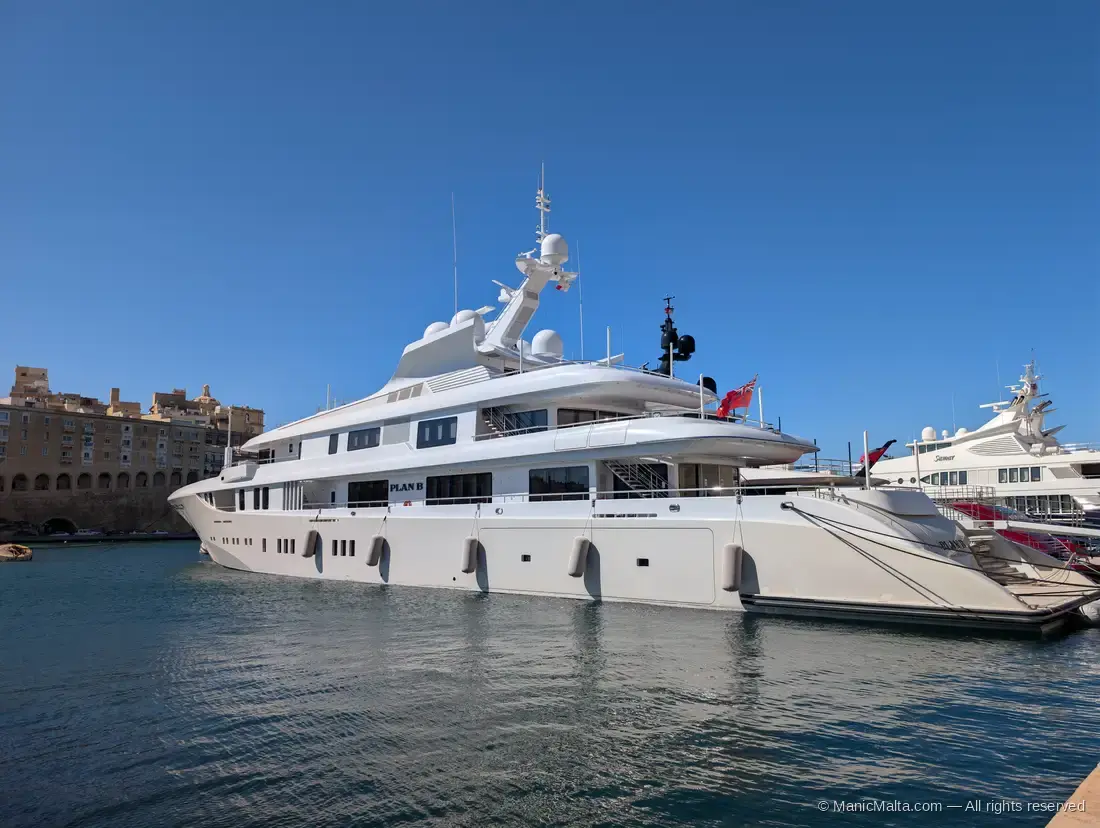
What to pair it with. The walk down to Vittoriosa’s waterfront and lunch at one of the marina-side restaurants directly under the fort walls; the contrast between superyachts moored below and Knights-era ramparts above is one of the better photographs of the trip. The Inquisitor’s Palace is a few streets inland and sits inside our broader Birgu coverage. A full Birgu-and-fort day works from any base in the harbour area.
Before you go — Fort St Angelo at a glance
| Detail | What to know |
|---|---|
| Where | Tip of the Birgu (Vittoriosa) peninsula, opposite Valletta — 📍 Google Maps |
| Run by | Heritage Malta. Tickets through heritagemalta.mt. |
| Time inside | 60 to 120 minutes. 90 minutes is the comfortable visit. Add 30 to 45 minutes for the approach. |
| Opening days | Days and hours change with the season. Confirm on the Heritage Malta page before you go. |
| Best time of day | First slot after opening. Mornings only in summer; the upper terraces are exposed. |
| Getting there | Water taxi from Valletta to Birgu is the most enjoyable. Buses run from Valletta. Driving and parking near Vittoriosa works early in the morning but tightens by mid-morning. |
| Accessibility | Sloping cobbled approach, uneven stone interior, scattered short stair sections. Lower courtyards are manageable for many visitors; the cavalier is a stretch. Wheelchair users should contact Heritage Malta in advance. |
| What to wear | Walking shoes, not sandals. Sun hat, sunscreen, water. A light layer in winter; the interior stone chambers are cool. |
| Pair it with | A Birgu collachio walk, the Inquisitor’s Palace, lunch on the Vittoriosa marina, and the water-taxi return to Valletta. |
| Photography | Allowed throughout the visitor route. The Vedette and the harbour-side bastion are the headline shots; the cavalier gives you the wide harbour panorama. |
FAQ
How long should I plan for a visit to Fort St Angelo?
About 90 minutes inside the fort is the comfortable visit. That gives enough time to walk the full route, read most of the interpretive panels, take photos and spend a few minutes on the cavalier. An hour is workable if you skim the panels. Closer to two hours if you read them carefully. Add 30 to 45 minutes for the walk from Vittoriosa waterfront to the entrance, and a bit longer again if you come in by water taxi from Valletta.
Is Fort St Angelo wheelchair accessible?
Partly. The entrance approach is a steep cobbled ramp, the interior route has uneven stone surfaces, and there are short stair sections in several places. Lower courtyards are manageable for many visitors; the upper cavalier is harder. If you are using a wheelchair, contact Heritage Malta in advance to confirm which sections of the route will be usable on the day of your visit.
How much does it cost to visit Fort St Angelo?
Tickets are sold through Heritage Malta and the price changes seasonally, with concessions for children, students and seniors. Combined multi-site Heritage Malta passes work out cheaper if you plan to visit two or more sites on the trip. Check the Heritage Malta Fort St Angelo page on the day rather than relying on numbers in a blog.
What is the difference between Fort St Angelo and Fort St Elmo?
Fort St Elmo sits on the tip of the Valletta peninsula and houses the National War Museum. The visit is heavier on artefacts and exhibits and is tied closely to the 1565 Great Siege. Fort St Angelo sits across the harbour on the Birgu side. Its visit is more about architecture and atmosphere, with panel-based interpretation rather than display cases. They are different experiences. Most visitors with time for both should do them on separate days.
What is the best time of day to visit Fort St Angelo?
The first slot after opening. The light is better on the harbour side in the morning, the site is quiet for the first hour before the cruise-ship and water-taxi groups arrive, and the cavalier is yours to photograph without other visitors in the frame. In summer mornings are essentially the only realistic time: by midday the upper terraces are in direct sun and the heat off the limestone is significant.
How do I get to Fort St Angelo from Valletta?
The water taxi from the Valletta waterfront to Birgu is the route most visitors enjoy most. It is a short crossing in a traditional Maltese dgħajsa tal-pass, and the approach to the fort by water is the approach it was built to receive. Buses also run from Valletta to the Three Cities. By car the Three Cities are 15 to 20 minutes from Valletta, but parking near Vittoriosa fills up by mid-morning.
Are children allowed inside Fort St Angelo?
Yes. Heritage Malta sells children’s tickets and the fort is open to family visitors. The visit involves walking on uneven stone, ramps and some stair sections. Small children who do not enjoy walking will find it long, while older children with any interest in fortifications, knights or military history usually engage with it well. There are railings around drop points, but the cavalier and upper bastions are exposed; stay close to younger children near the parapets.
Can I take photographs inside Fort St Angelo?
Yes, throughout the visitor route. Phones and cameras are fine. Tripods are usually fine for handheld photographers but check at the entrance if you are carrying serious gear. The Vedette and the harbour-side bastion are the photographs most visitors leave with. The cavalier gives you the wide harbour panorama, and the parapets facing the breakwater are where to try a long-exposure shot if your phone supports it.
Are there costumed knights or reenactors at Fort St Angelo?
Sometimes. Heritage Malta runs costumed historical interpretation on the upper bastions on certain weekends. This is not the full In Guardia parade you may have seen advertised at Fort St Elmo, but a smaller-scale display with interpreters in Knights-era and noble dress. The schedule is published on the Heritage Malta site; if a weekend interpretation day falls inside your trip, it is worth timing the visit around it.
Was Fort St Angelo used in Game of Thrones?
Yes, in passing. Fort St Angelo and several other Maltese fortifications were used as locations for the first season of Game of Thrones, shot in 2010 and aired in 2011. The interior chambers are not signposted as filming locations on the visitor route and Heritage Malta does not lean on the connection. If you are visiting for the architecture and the history, this is a footnote rather than the headline.
Is the Inquisitor’s Palace included with the Fort St Angelo ticket?
Not on a single ticket, but both sites are run by Heritage Malta and a multi-site pass covers both. The Inquisitor’s Palace sits a few streets inland from the waterfront in Birgu and is one of the natural pairings for a half-day in the Three Cities. Most visitors who do Fort St Angelo in the morning fit the Inquisitor’s Palace in either before lunch or after.
Is Fort St Angelo worth visiting if I only have one day in Malta?
If your day is in Valletta and the harbour area, yes. The water-taxi crossing, the fort visit, lunch on the Vittoriosa marina and the boat back to Valletta is a strong single-day plan and shows you the version of Malta that you cannot get from Sliema or the beaches. If your only day is elsewhere (Mdina, Gozo, the temples) the geography may not work, and a half-day in Valletta itself is the safer call. Our wider Fortress Malta piece sets out how the harbour fortifications connect.
About this piece. Written from one visit in February 2026. Photos are ours from that morning. Not sponsored. Prices, hours and event dates change; for those we link to Heritage Malta rather than quoting numbers that will go out of date.
Last updated: 18 May 2026.
Stay in Gżira near the promenade
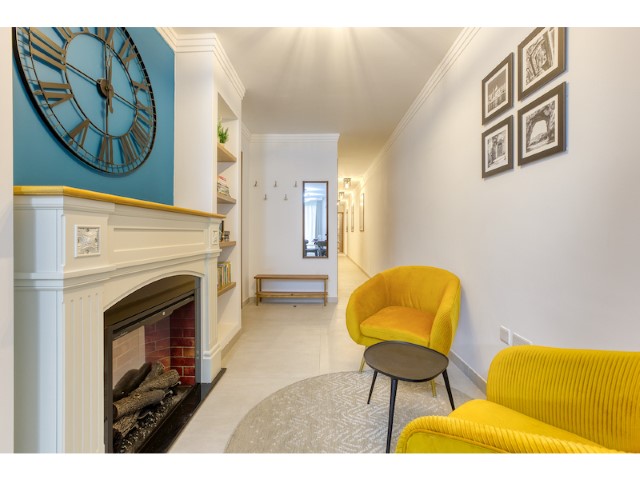
A designer 2-bedroom apartment in Gżira, close to the church, around 2 minutes from the promenade, and near Manoel Island.
View on Airbnb