Marsaxlokk Boats: A Walk Around Malta’s Most Photographed Harbour

TL;DR — THE 30-SECOND VERSION

Marsaxlokk is Malta’s fishing port and its most photographed stretch of water. Saturday 2 May 2026, mid-morning, before the Sunday market crowd. Thirty-seven photos of the luzzu fleet on the water, boats up on stands being restored along the waterfront, the LNG tanker that has not moved since 2017, fishing nets coiled on the quay, and a few of the modern boats that share the harbour with the painted ones.

  • Where: Marsaxlokk harbour, south-east Malta — about 25 minutes from Valletta by bus (81, 85)
  • When the photos were taken: Saturday morning, 2 May 2026 — clear, light wind, sea flat
  • Best for: luzzu boats up close, the working-harbour side of Marsaxlokk, harbour panoramas without Sunday-market foot traffic
  • Pair this page with: the Malta events calendar and our south-coast beaches guide
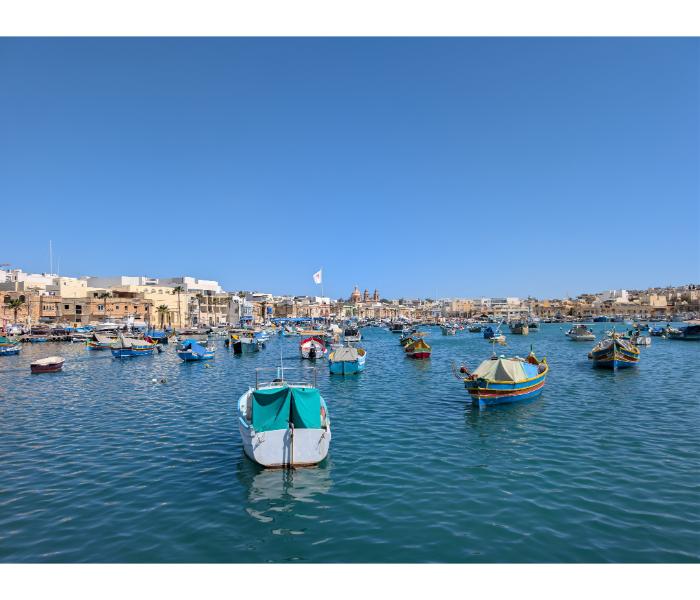
Wide panorama of Marsaxlokk harbour with the parish church of Our Lady of Pompei visible across the waterfront and dozens of small boats moored across the bay
Marsaxlokk on a clear May morning. The parish church of Our Lady of Pompei sits dead centre on the waterfront; the dome anchors every wide shot of the bay.

Marsaxlokk (pronounced mar-sash-lock) is Malta’s largest fishing harbour and the place most visitors come to see the luzzu, the traditional Maltese fishing boat with the painted eye on the bow — sometimes attributed to Phoenician roots, sometimes to the Egyptian eye of Osiris — meant to protect the fisherman at sea. The Sunday fish market is the postcard. The harbour itself works every day of the week.

This is a Saturday-morning walk around the bay before the market sets up, photographed on 2 May 2026. The luzzu fleet sits on the water in the south-east corner. A line of boats up on stands along the kerb is being scraped, sanded, and repainted by their owners. The LNG floating-storage tanker, rebadged “LNG FSU”, looms across the bay from Delimara Point, where it has been moored since 2017. The chimneys of Delimara power station rise behind it. In the middle of all of that, a duck stands on a blue rowing boat.

If you are pairing this with the rest of the south coast, our Malta events calendar and our day-trips guide cover the rest. Visit Malta on Marsaxlokk has the basic visitor information.

The Luzzu Fleet on the Water

Bright paint, painted eyes, more variety than the postcards suggest

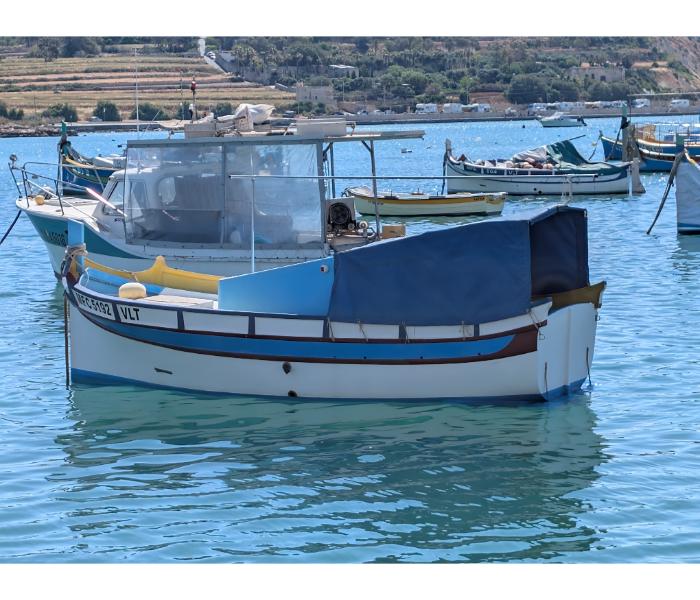
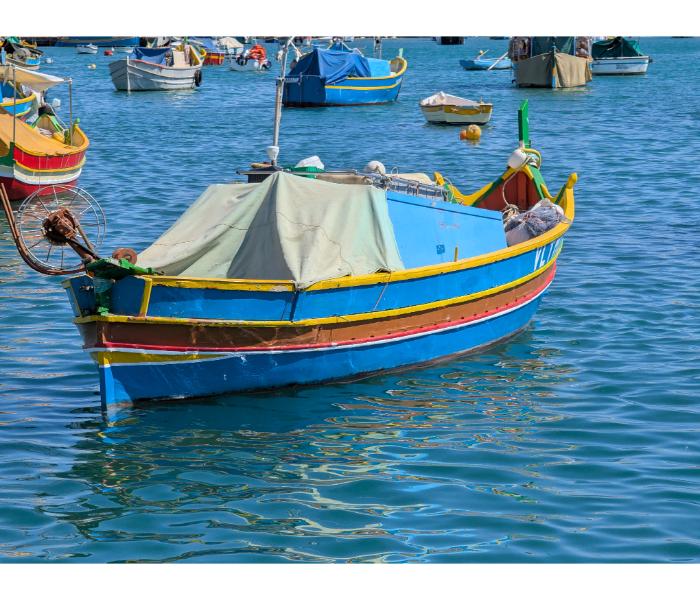
The first impression of Marsaxlokk is the colour. Cobalt blue hulls, yellow upper strakes, red and green trim along the gunwales. Each boat is painted by its owner. The palette stays consistent across the fleet but no two boats are identical: the patterns on the bow, the names along the side, the small details on the rudder are all individual. Most of the larger boats here are registered in Valletta (the “VLT” plate) even though they work out of Marsaxlokk; the Maltese fishing fleet is administratively centralised, not geographically.
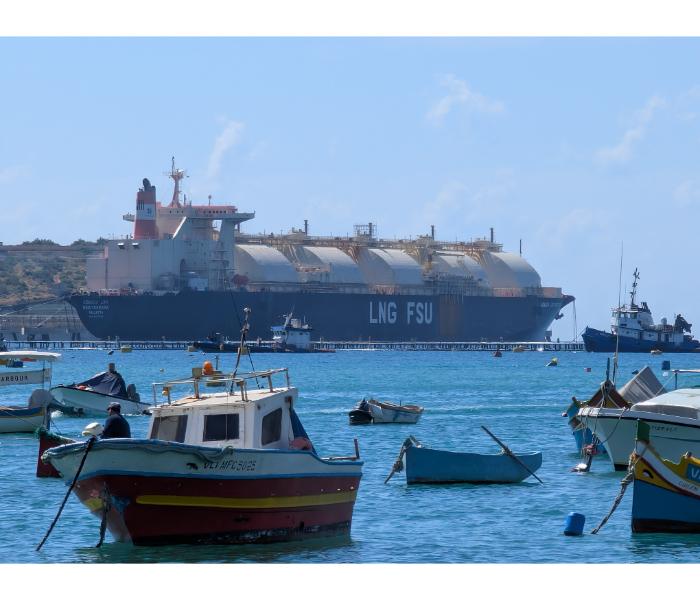
Traditional Maltese luzzu fishing boats moored in Marsaxlokk harbour with the LNG FSU floating storage tanker filling the horizon behind them
Luzzu fleet in front of the LNG FSU. Centuries-old fishing boat in the foreground, gas-storage tanker on the horizon. Modern Marsaxlokk in one frame.
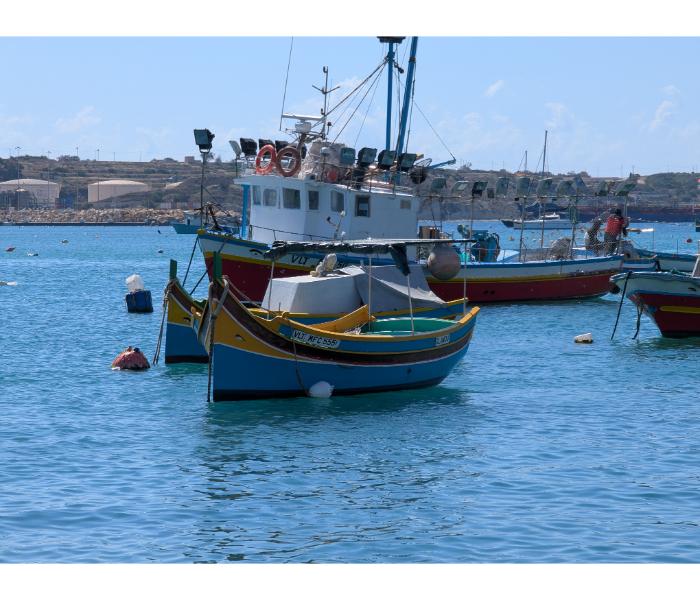
A pair of traditional Maltese luzzu boats with the painted eye of Osiris on each bow, moored close to the Marsaxlokk waterfront
The painted eye on the bow is the bit everyone photographs. The Phoenician origin is contested by historians; the practice of painting it has been continuous for centuries.
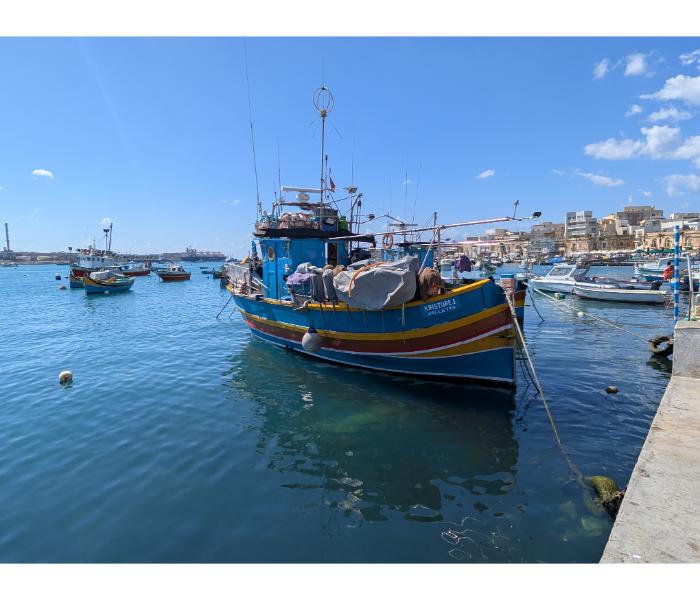
Blue and yellow luzzu Kristofer J registered in Valletta, moored alongside the Marsaxlokk waterfront
The Kristofer J from Valletta. The square wheelhouse and rigging mark this out as a working motor luzzu, not a tour boat.
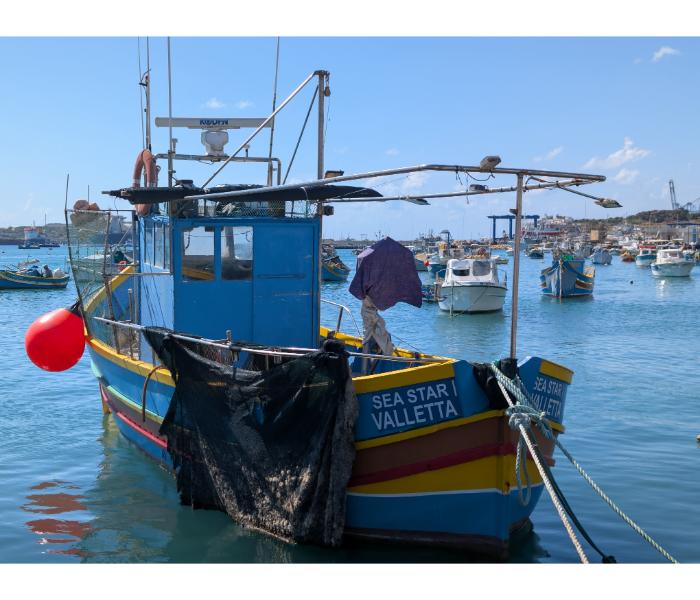
The blue and yellow fishing boat Sea Star registered in Valletta, with a red mooring buoy alongside, photographed in Marsaxlokk harbour
The Sea Star. The radar arch and net-drying rigging up top are functional; this boat goes out to fish.
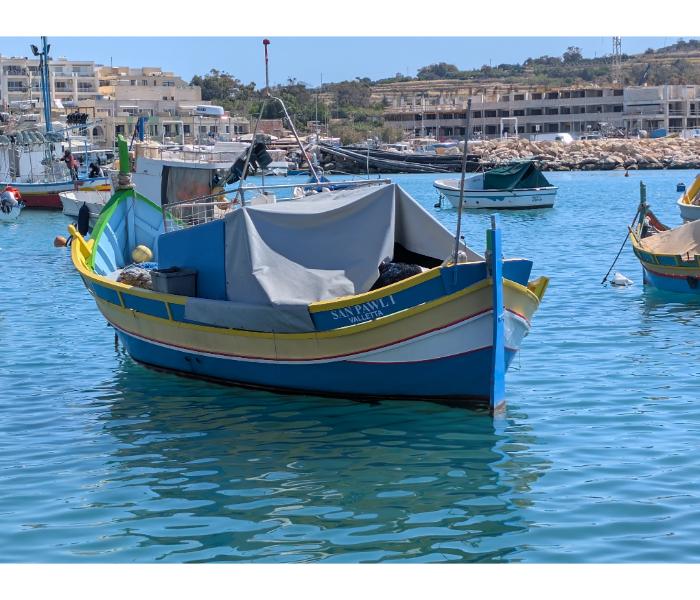
The luzzu San Pawl, painted blue and yellow with traditional Maltese trim, moored in Marsaxlokk harbour with a hillside village in the background
The San Pawl. Most luzzu names are religious — saints, biblical figures, prayers for safe return — a continuity older than the engines.
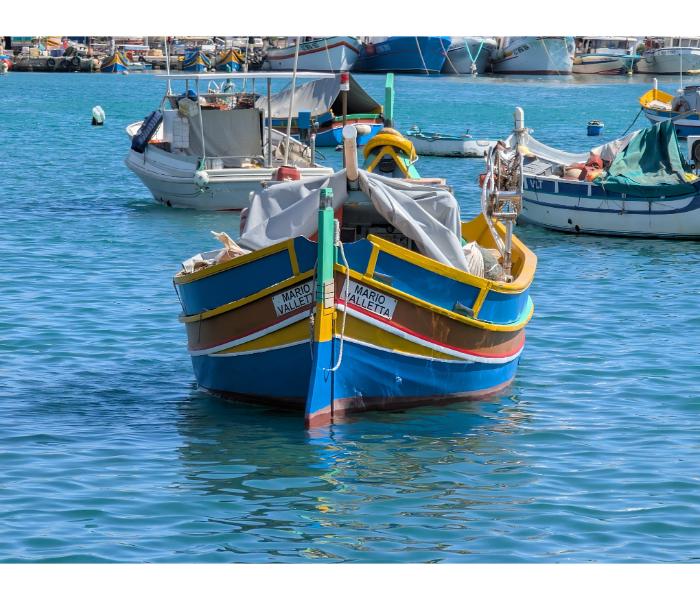
The Mario, a Valletta-registered luzzu, photographed head-on in Marsaxlokk harbour with other boats moored in the background
The Mario, bow-on. Note the asymmetric painted eyes — left and right are deliberately a little different on every luzzu.
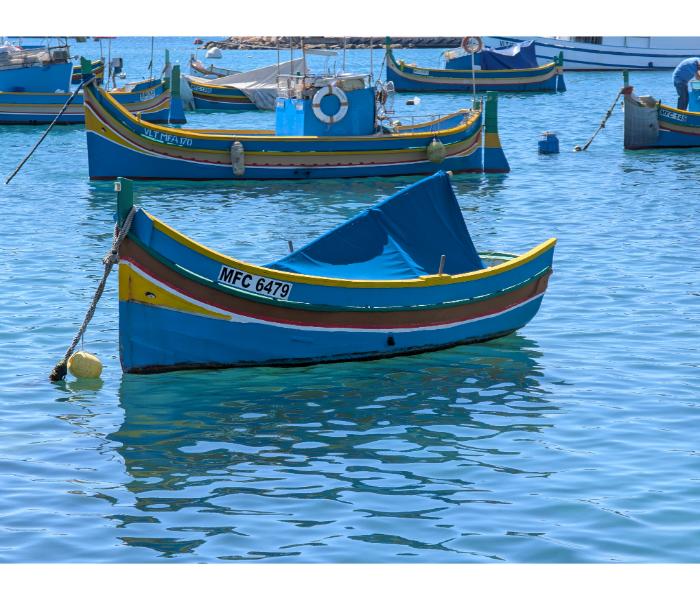
Bright blue luzzu numbered MFC 6479 with traditional yellow and red trim, moored at a Marsaxlokk buoy
MFC 6479. The MFC plate is a Marsaxlokk Fishing Centre registration — a sub-category within the Maltese fleet.
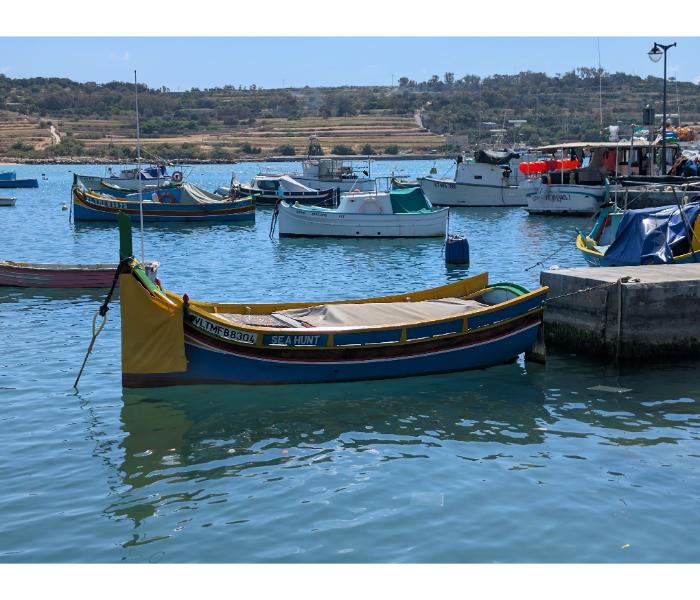
The luzzu Sea Hunt from Valletta moored close to the Marsaxlokk quay with other fishing boats and a low hillside behind
The Sea Hunt. Yellow upper hull, blue mid-band, red waterline — the classic three-stripe luzzu paint scheme.
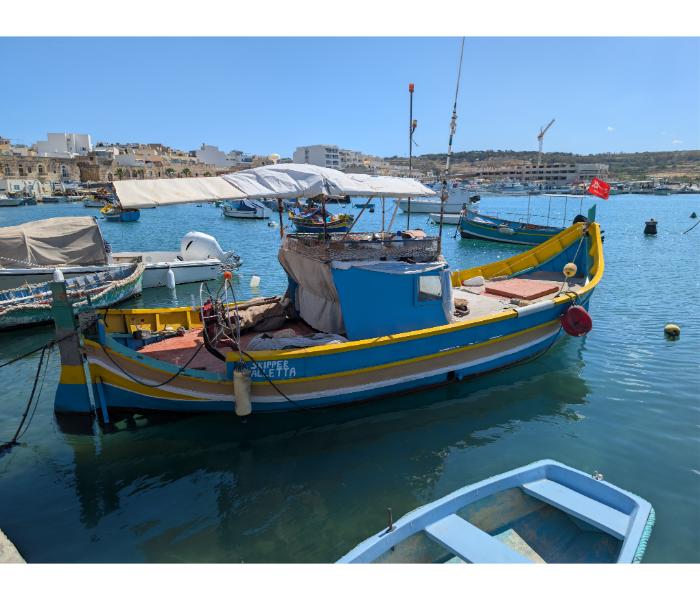
The luzzu Skipper from Valletta with a fitted sun awning over the cockpit, moored in Marsaxlokk harbour
The Skipper, awning rigged. Most working luzzu carry a fixed canvas frame; the sun on the water is brutal by midday.
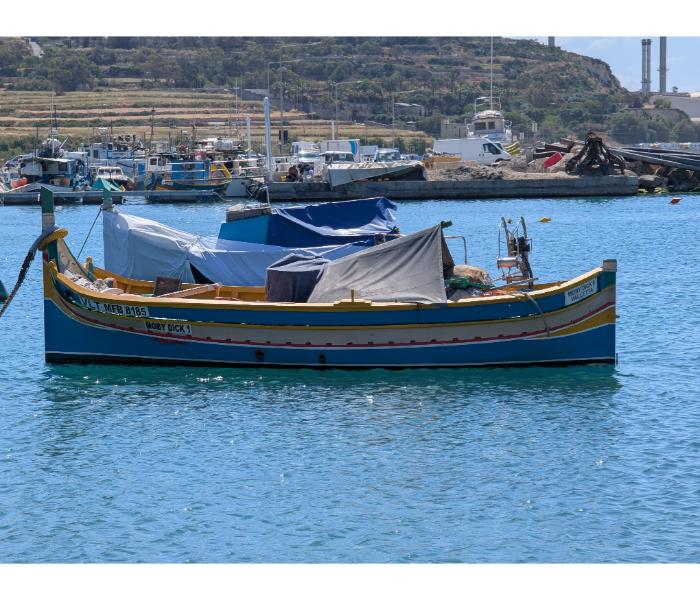
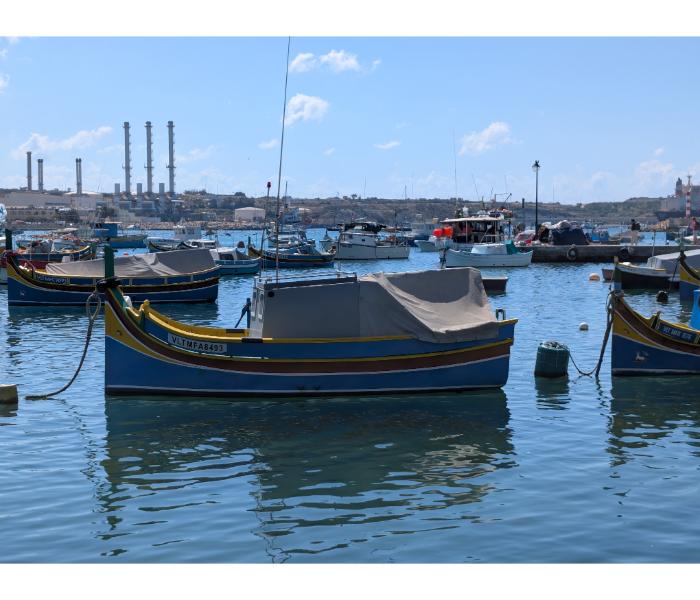
The luzzu Moby Dick 1 from Valletta with covered cockpit moored in Marsaxlokk with Delimara power station chimneys on the headland behind
The Moby Dick 1. Out for the morning, ready to come back in. The Delimara chimneys behind it make the location obvious.
Blue cabin luzzu fishing boat moored close to the Marsaxlokk waterfront with hillside terraced fields visible across the bay
The terraced fields across the bay run up to Birżebbuġa. Marsaxlokk is small; the next village is always within sight.
Two luzzu boats moored in Marsaxlokk harbour with the four red-and-white chimneys of Delimara power station rising directly behind them
Delimara power station is the bay’s other constant landmark. Most postcards crop it out.
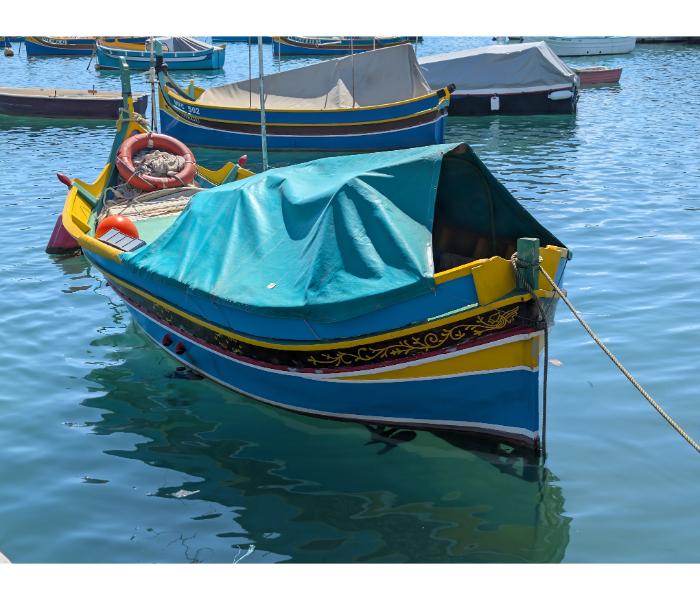
Maltese luzzu under a teal tarpaulin with bright yellow trim, floral painted decoration on the side, and the harbour quay behind
Painted floral decoration along the strakes — older than the boat itself, the pattern is repainted every restoration.
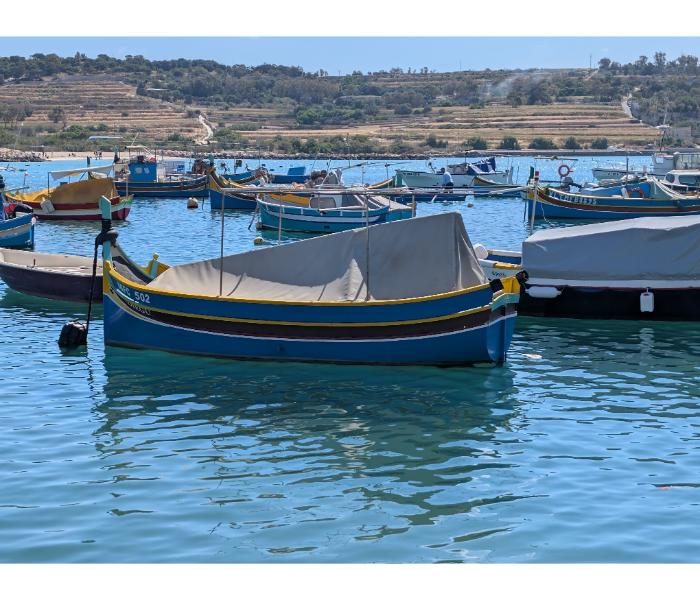
Yellow and blue luzzu numbered MFC 502 covered with a grey tarp, moored among other boats in Marsaxlokk harbour
MFC 502 under cover. Tarpaulins on a still morning give the harbour a closed-shop look — it lifts by noon.
Maltese luzzu under a fitted canvas cover with bright yellow trim and traditional bow decoration, surrounded by other moored fishing boats in Marsaxlokk harbour
Fitted canvas covers are bespoke — built to fit the cockpit of each individual boat.
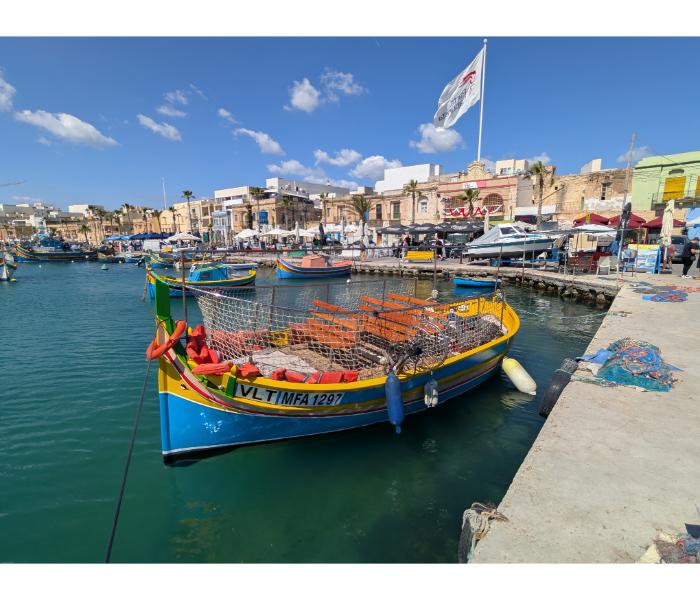
Luzzu VLT MFA 1297 in Marsaxlokk harbour with stacked wicker fish traps in the foreground and the Sunday market stalls being set up on the quay behind
VLT MFA 1297. The wicker pots are nases — traditional fish traps. The umbrellas on the quay are the market setting up.

Boats Ashore — What the Postcards Don’t Show

The unglamorous half of keeping a wooden boat alive in the Mediterranean

What the standard Marsaxlokk photograph misses is the line of boats up on stands along the waterfront. Wooden boats in the Mediterranean need constant work. Salt eats the timber, sun cooks the paint, and every two or three years each luzzu comes out of the water for sanding, refastening, and repainting. The work is done in the open air, by the owner, on the kerb, with a ladder. Not romantic. It is also why these boats last generations.
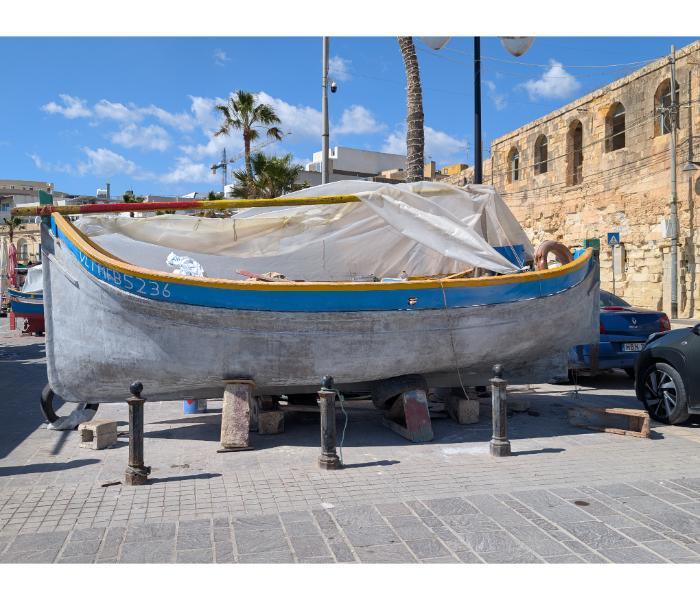
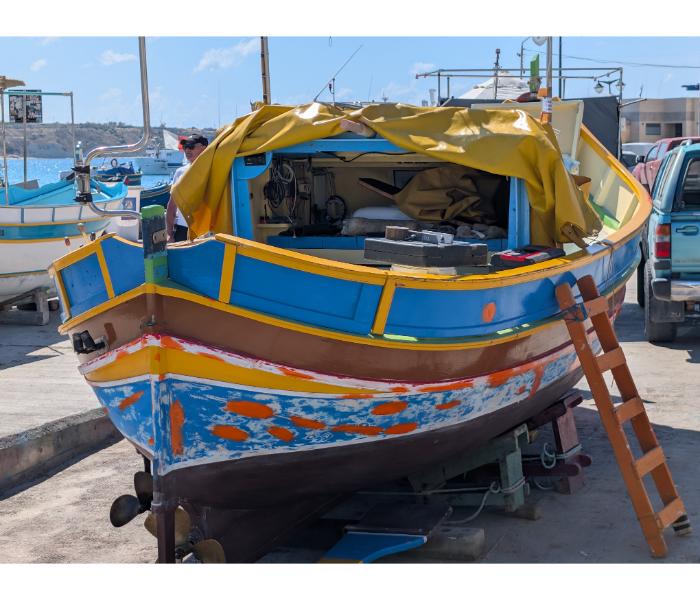
An unpainted Maltese fishing boat propped on stands ashore at Marsaxlokk with a canvas cover over the cockpit and a palm tree behind on the waterfront
Stripped back to bare timber. The plastic sheeting keeps the dust out of the cockpit while the hull is being worked.
A luzzu mid-restoration ashore in Marsaxlokk with peeling paint on the hull, an orange ladder leaning against the side, and the owner working in the background
Mid-job. The orange spots are filler for surface gouges; the next coat will cover everything.
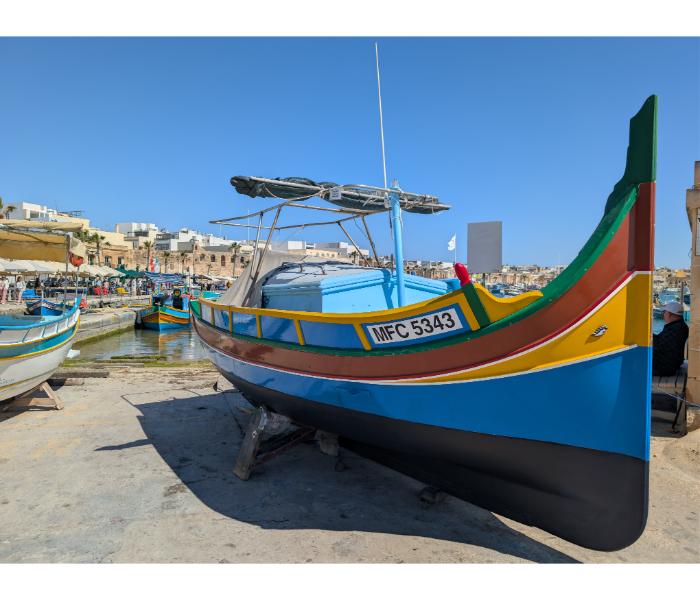
Freshly restored blue luzzu numbered MFC 5343 on stands ashore in Marsaxlokk, with traditional yellow, red, and green trim and a new black waterline
MFC 5343, finished. Ready for the lift back into the water — probably within the week.
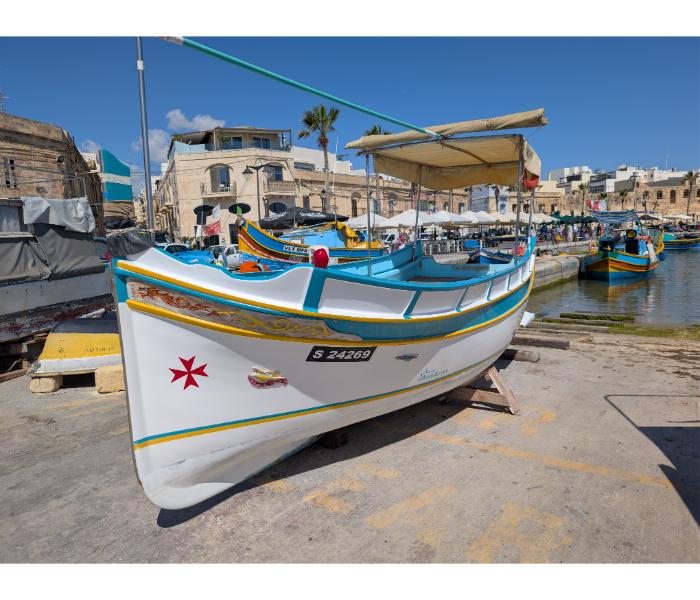
Restored white luzzu numbered S 24269 ashore in Marsaxlokk with the eight-pointed Maltese cross painted on the bow and the market crowd visible behind
S 24269 with the eight-pointed Maltese cross. A tour boat dressed up for the photo.

The LNG Tanker on the Horizon

Why every wide shot of Marsaxlokk includes a gas tanker

The grey ship that fills the back of every wide-angle photo of the harbour is the LNG FSU, the floating storage unit moored off Delimara Point that supplies the adjacent gas power station. It has been there since 2017 and is the subject of an ongoing local and national argument. Politics aside, it is a permanent feature of the view, and the photos below show it the way you actually see it from the quay.
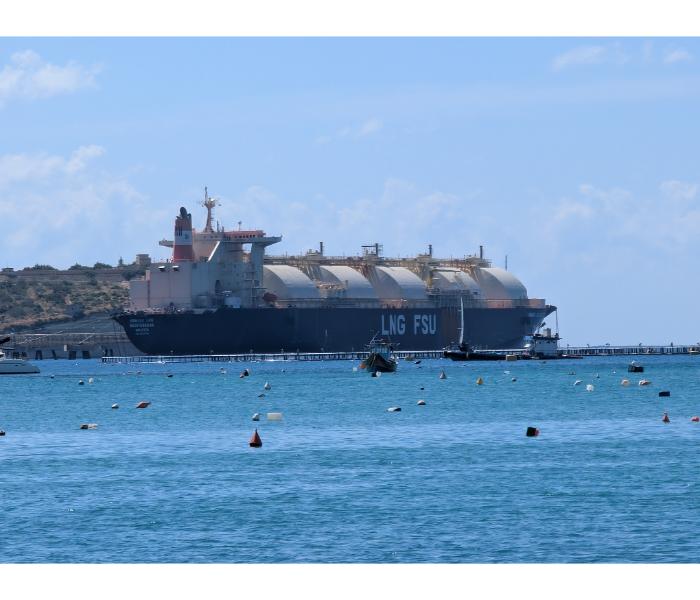
Side-on wide view of the LNG FSU floating storage unit moored in Marsaxlokk Bay, with its row of large spherical gas tanks visible along the deck and small mooring buoys in the foreground
The LNG FSU side-on. The spherical tanks along the deck are the storage cells; the gas is piped ashore to the power station next door.
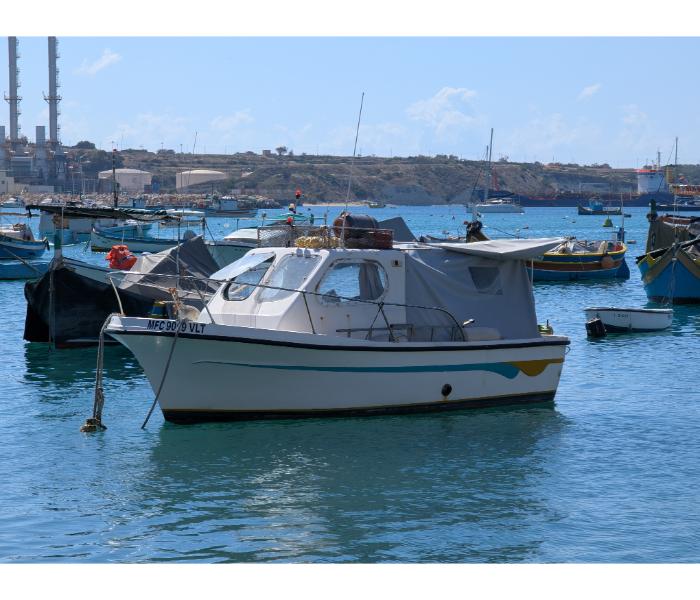
A small white cabin boat at the Marsaxlokk waterfront with the four red-and-white chimneys of Delimara power station rising directly behind on the headland
Chimneys behind, harbour in front, water glass-flat between them.

The Working Harbour

Nets on the quay, derelict hulls, a duck, and a workboat full of fish traps

Tourist Marsaxlokk is luzzu-and-church. Working Marsaxlokk is fishing nets piled on the kerb, a half-flooded rowing boat nobody has dealt with in two seasons, a tender with an outboard tied alongside the parent boat, and a duck that has claimed one of the moored skiffs.
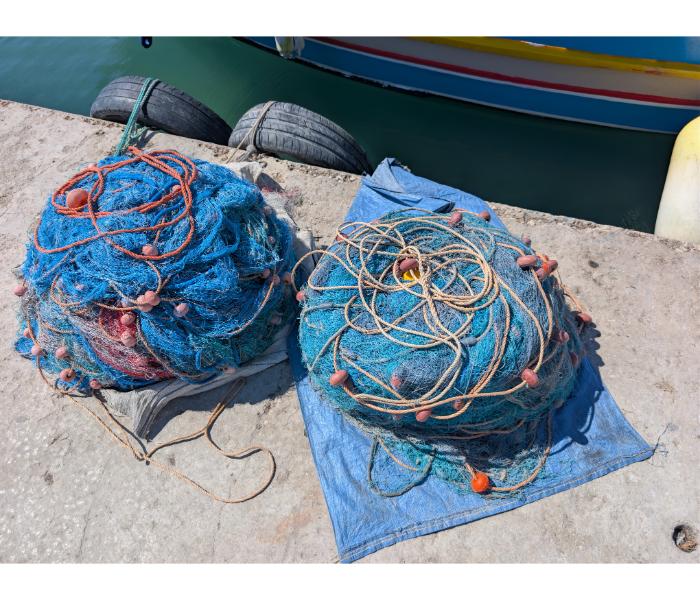
Two large piles of blue fishing nets with coiled rope and orange floats laid out on a tarp on the Marsaxlokk quay, with a luzzu hull visible behind
Nets and rope on the quay. They are laid out for repair, not display.
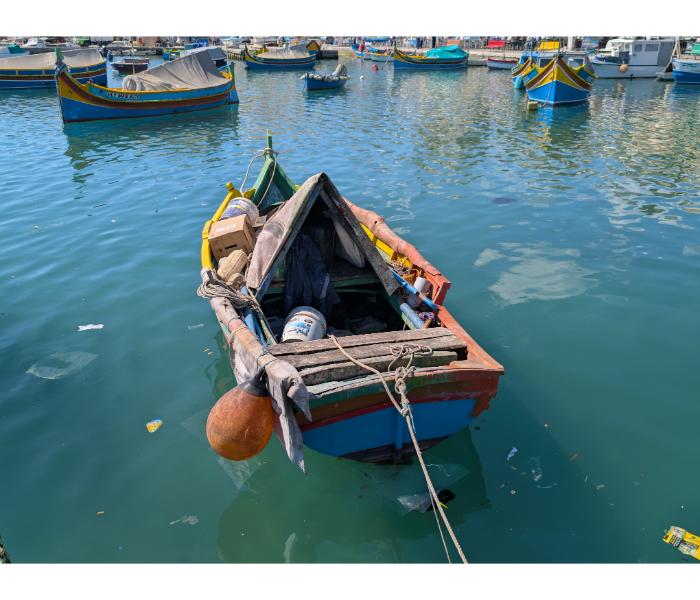
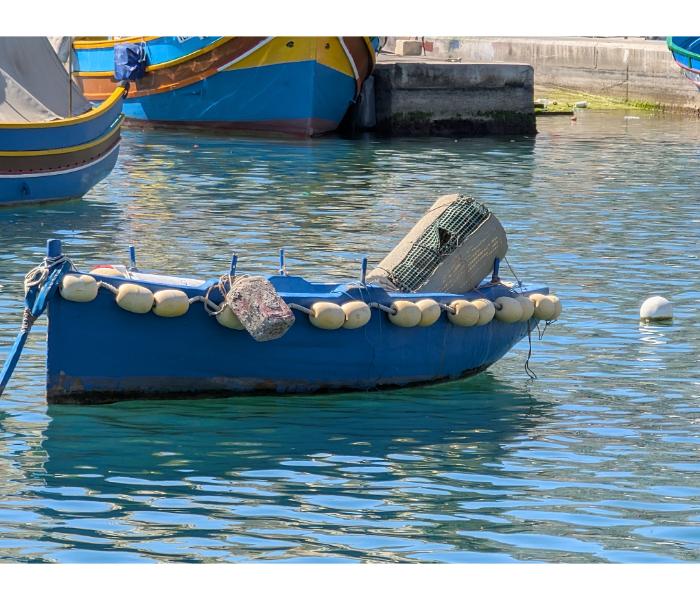
Blue Maltese workboat strung with a line of yellow round floats along the gunwale and a wicker fish trap on board, moored at the Marsaxlokk quay
The line of yellow buoys runs the length of a longline. The wicker box is one of the nases from earlier, but loaded and ready.
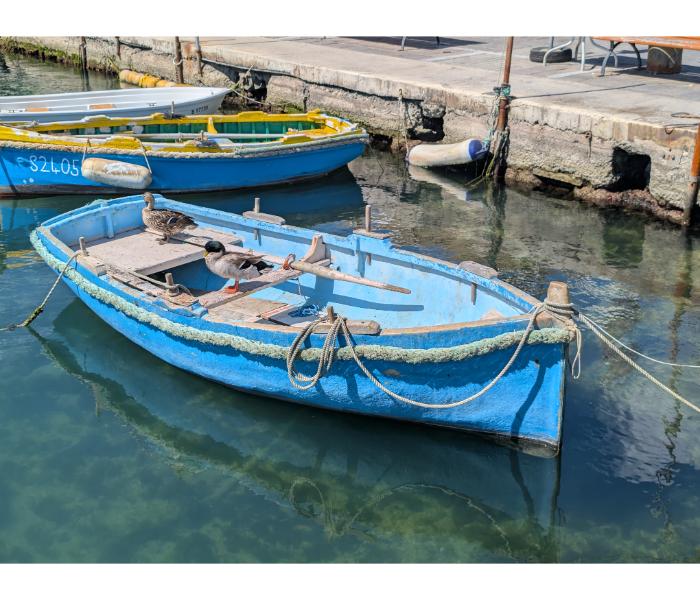
A small blue wooden rowing boat moored against a stone quay in Marsaxlokk with a mallard duck standing on the gunwale
The duck is not for scale.
A small wooden rowing boat half-flooded and abandoned in Marsaxlokk harbour, photographed from above the quay with other boats moored in the background
One that did not make it back into the rotation. There are always one or two.
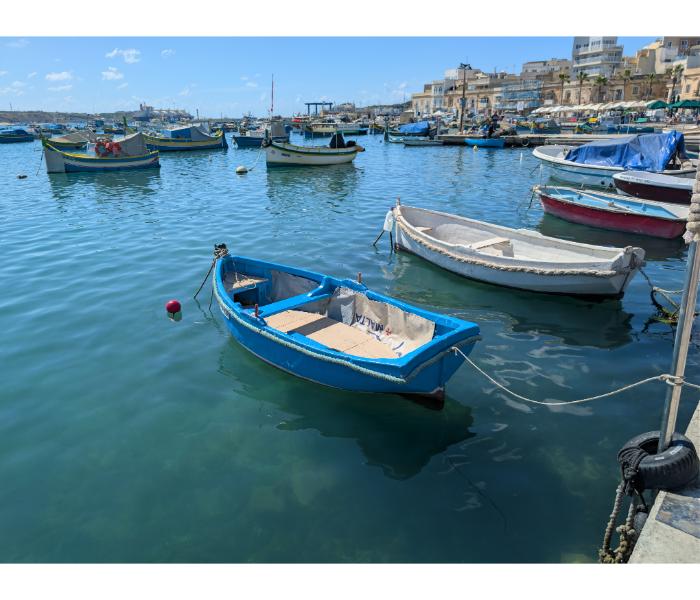
A small blue rowing boat in the foreground with the full sweep of Marsaxlokk harbour and its boats spread out behind
Empty rowboat, full harbour. The composition Marsaxlokk gives you for free.
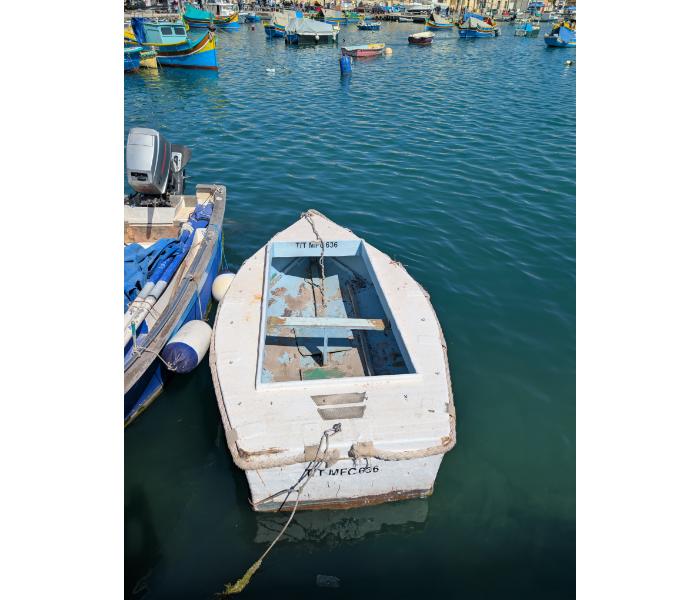
White tender numbered T/T MFC 636 with a small outboard engine moored alongside its larger parent fishing boat in Marsaxlokk
T/T MFC 636 — the “T/T” means tender-to-MFC-636. Most working luzzu carry one.
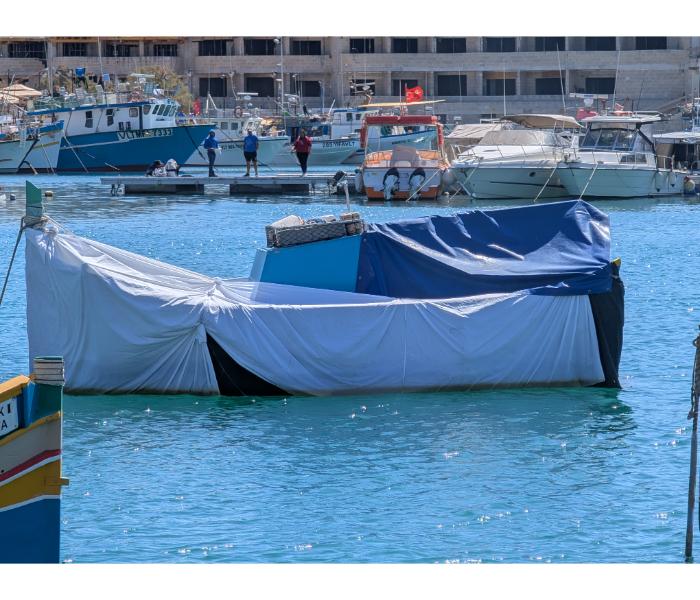
A boat almost entirely wrapped in a white tarpaulin floating in Marsaxlokk harbour, with the tarp tied down over what would be the cockpit
Tarped from stem to stern. Out of season for this one — or storage between owners.
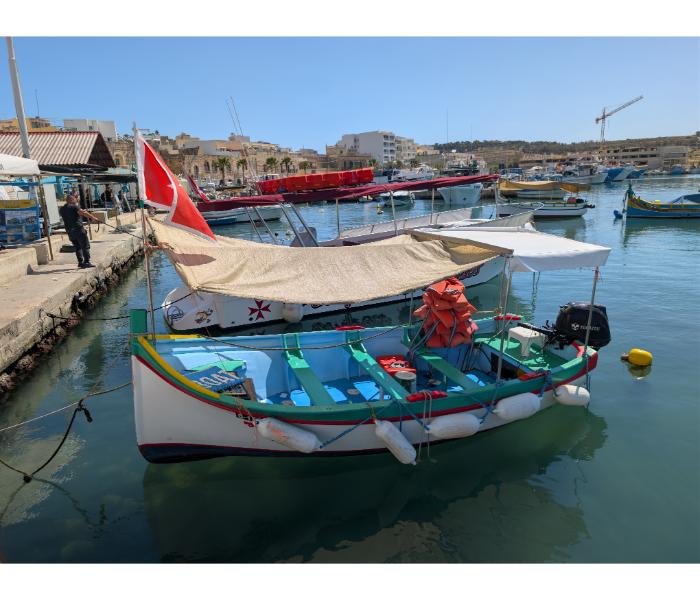
A traditional Maltese wooden rowing boat with a small Maltese cross flag, painted bench seats, and an orange figurehead, tied up at the Marsaxlokk waterfront
Wooden rowing boat dressed up for the tourists. Note the Maltese cross on the awning.

The Modern Boats Sharing the Harbour

Tour boats, RIBs, and the cabin cruisers that work the same water

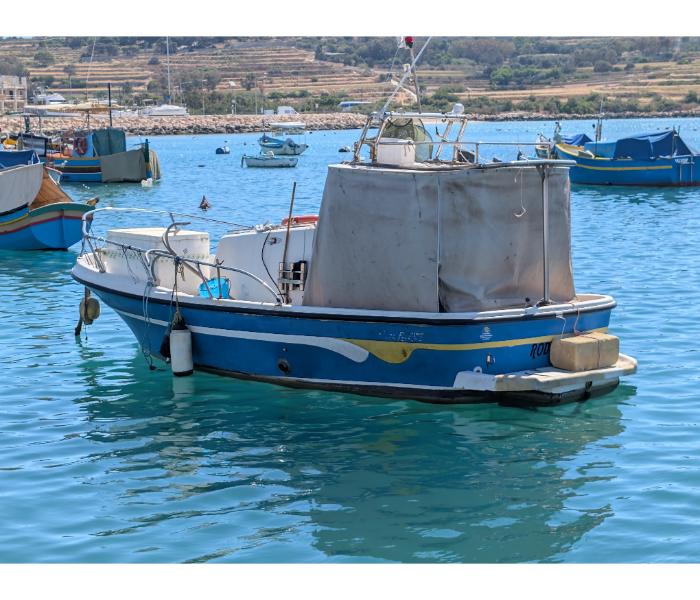
The luzzu are the headline. They share the harbour with motor cruisers, fibreglass cabin boats, the Captain Zuzu tour fleet that runs trips around the south coast in summer, and the occasional modern RIB on a trailer in the village. Marsaxlokk is a live working harbour, not a heritage museum.
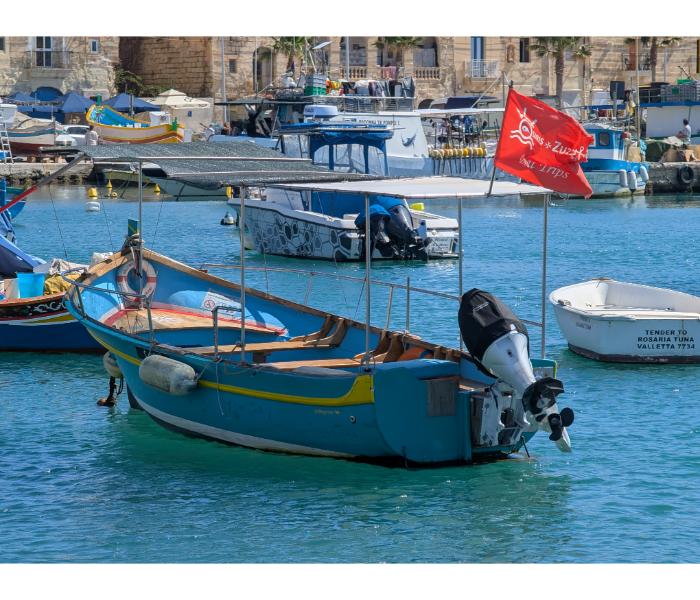
Blue Captain Zuzu tour boat with a red banner flag and white sun canopy moored at the Marsaxlokk waterfront, with the village and a luzzu visible behind
The Captain Zuzu tour boats run summer trips around the south coast — Blue Grotto, Filfla, the cliffs.
A blue and white motorboat moored at the Marsaxlokk quayside with a luzzu visible alongside and the village waterfront in the background
Mid-size motor cruiser. The harbour fits these alongside the luzzu without much fuss.
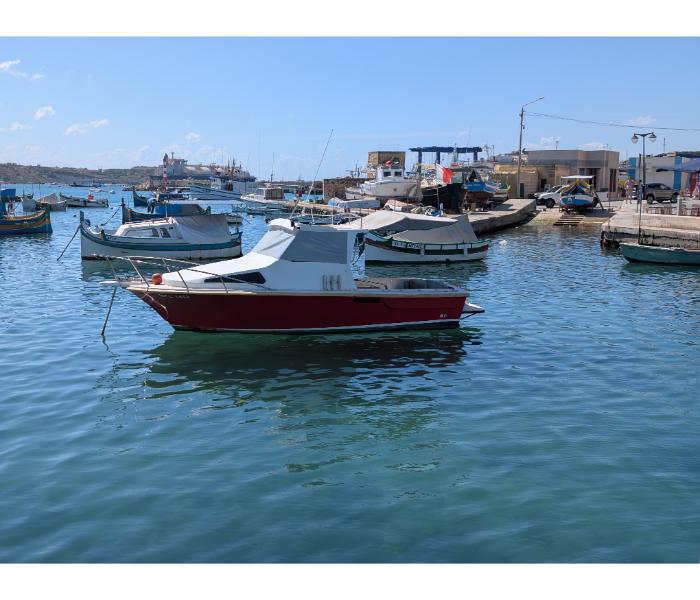
Red and white cabin cruiser at anchor in Marsaxlokk harbour with other fishing boats and the village waterfront visible behind
Red and white cabin cruiser. Not a fishing boat — somebody’s weekend rig.
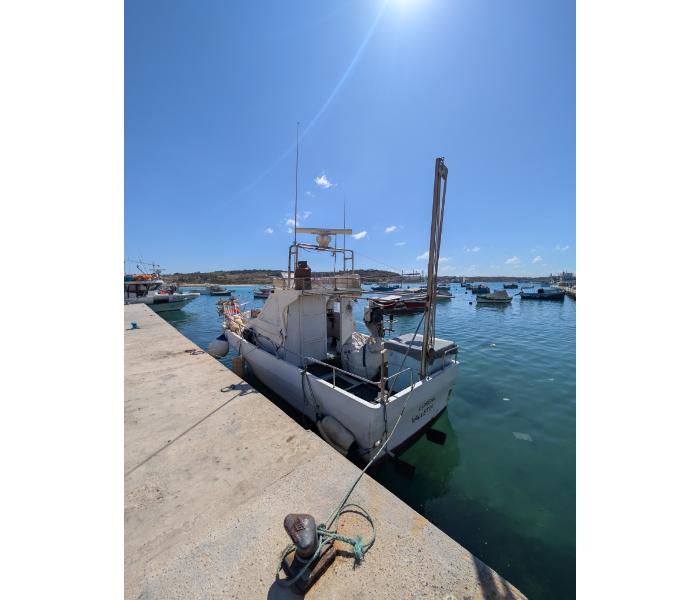
White motorboat moored at the Marsaxlokk stone quay on a still bright morning with the harbour and hillside visible across the bay
Still morning. Mooring lines slack. The water in May is already warm enough to swim in.
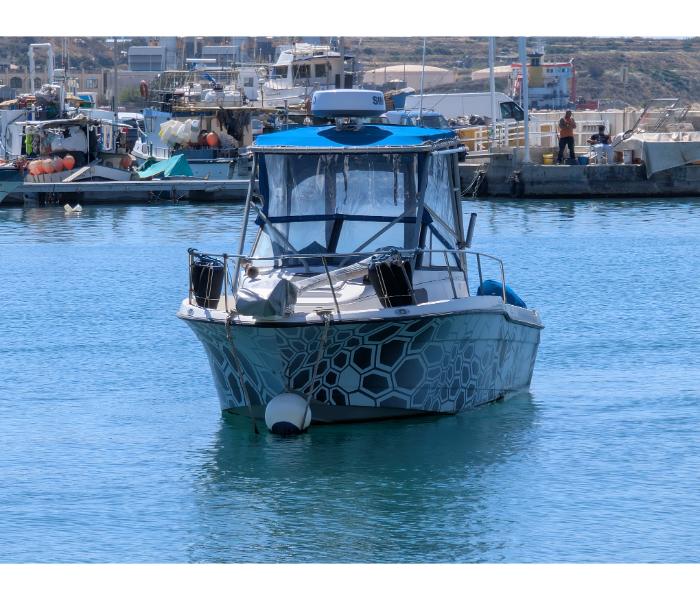
Modern cabin boat with a grey hexagonal camouflage pattern on the hull moored in Marsaxlokk harbour with other fishing boats and the waterfront in the background
Hex-camo hull on a new cabin boat. Marsaxlokk is not just luzzu.
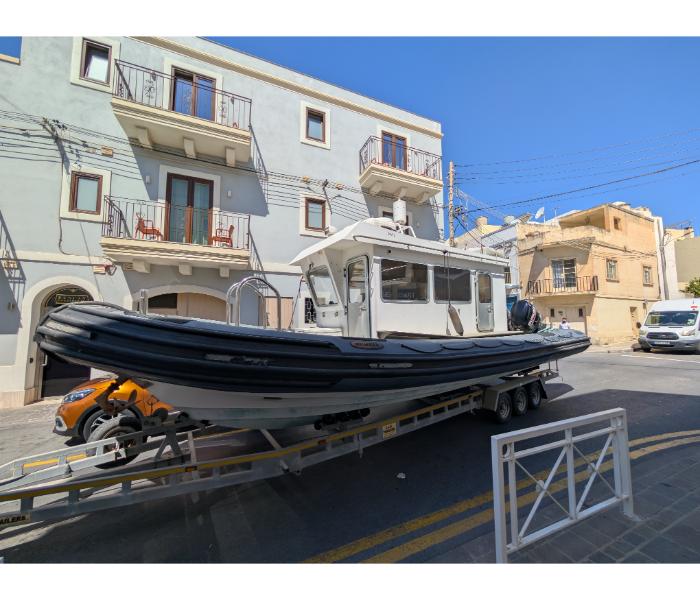
A large modern rigid inflatable boat on a trailer being towed through a narrow side street in Marsaxlokk village with traditional Maltese balconied houses on either side
End of the walk. RIB on a trailer, threading down a side street one balcony wider than it has any right to be.

Getting to Marsaxlokk

Practical details if you want to come and photograph the harbour yourself

By bus. Route 81 from Valletta to Marsaxlokk takes 30–45 minutes depending on traffic and runs roughly every 30 minutes through the day. Route 85 connects from the south. Tallinja card the same as any other Maltese bus route. There is no train.

By car. Parking on the waterfront is paid and busy from mid-morning. The free overflow car park is a five-minute walk north of the bay. Avoid Sunday between 09:00 and 13:00 unless you are coming for the market specifically — the village fills up and the harbour-front road becomes pedestrian-priority.

Best time of day for photos. Early morning, particularly midweek, particularly outside July–August. The water is flattest before the wind picks up, the colours of the luzzu are at their richest in the lower-angle light, and you can get the harbour without crowds. We were on the quay by 09:30 on a Saturday in May — the light was already strong but the boats had not started moving.

Sunday market. Runs along the waterfront every Sunday morning, year-round, regardless of weather. Fresh fish at the eastern end, tourist stalls along the western end, cafés and restaurants in between. Go early for the fish (08:00–09:30); go later if you only want the atmosphere and a coffee.

Where to eat. The waterfront restaurants are where Maltese families come from the rest of the island for Sunday lunch. Reserve. The classic order is grilled local fish (lampuki in season, August onwards) with capers and tomato — and the rabbit, if you have not had it elsewhere, is worth ordering here.

Pro tip: If you want the harbour without the market, go Saturday or any weekday. The fish comes out of the same boats six days a week; Sunday is when the public-facing stalls go up. The luzzu are easier to photograph without 200 people leaning over the railing in front of you.

Marsaxlokk Boats — FAQ

What is a luzzu? A luzzu is a traditional Maltese fishing boat, brightly painted, with the protective eye on the bow that is variously attributed to Phoenician or Egyptian roots. The hull form is recognisable from photographs going back to the 19th century; materials and paint have evolved, the silhouette has not. Most working luzzu in Marsaxlokk today carry inboard or outboard motors; the older sailing versions are rare.

Why are the boats so brightly coloured? Each owner paints their own boat. The conventions (blue and yellow upper sections, red and green trim along the gunwales, the eye on the bow) are inherited. The eye is said to protect the fisherman at sea; the colours make individual boats identifiable from a distance. There is no centralised colour scheme.

Is Marsaxlokk worth visiting if it is not Sunday? Yes — and for photography, it is better. The fish market runs once a week, but the working harbour runs every day. The light is best on weekday mornings, and you can walk the full length of the waterfront without crowds.

What is the large ship in the bay? The LNG FSU is the floating storage unit moored at Delimara Point to supply the adjacent gas-fired power station. It has been there since 2017 and dominates the horizon in any wide shot of the bay. It is not going anywhere in the near future.

Can I take a boat trip from Marsaxlokk? Yes — the Captain Zuzu fleet and several other operators run summer trips from the harbour to the Blue Grotto, the cliffs of the south coast, and (less commonly) Filfla. The season runs roughly April to October. Trips are advertised on the harbour railing and at the village kiosks.

How long should I plan for a visit? Two hours is enough for the harbour walk, the church, and a coffee. Three to four hours covers the market, lunch, and an unhurried walk along the full length of the bay. Half a day if you are pairing it with St Peter’s Pool or a boat trip.

Marsaxlokk is one stop on the south coast. From the same morning you can reach St Peter’s Pool (the natural swimming bay 20 minutes’ walk out of the village), Marsaskala (the next harbour around), and the Blue Grotto on the south coast.

For the full month-by-month picture, see our Malta events calendar, our south-coast beaches guide, our day-trips from Sliema, and the wider where-to-stay guide if you have not booked a base yet. The Festivals Malta site has the official cultural-events programme; Visit Malta on Marsaxlokk has the basic visitor information.

Sponsored

Stay in Gżira near the promenade

Designer 2-bedroom apartment in Gżira

A designer 2-bedroom apartment in Gżira, close to the church, around 2 minutes from the promenade, and near Manoel Island.

View on Airbnb