

TL;DR — THE 30-SECOND VERSION
If you only remember one thing: in Malta the exact street matters almost as much as the area name.
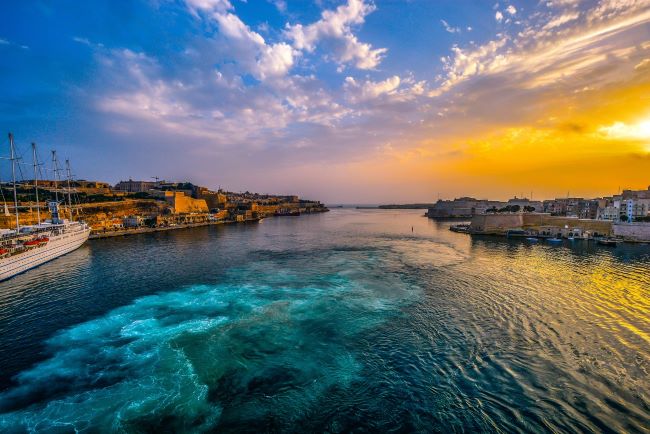
- Best for atmosphere: Valletta — the most striking place to stay, and the one most likely to irritate you if you hate stairs, slopes, or tight old-city streets.
- Best for ease: Sliema — promenade, ferry, shops, flatter walking, fewer annoying little decisions.
- Best for nightlife and restaurants: St Julian’s — Paceville energy if you want it, Spinola Bay if you do not.
- Best value hack: Gżira — the area most guides skip. Central harbour access, easier parking, better apartment odds, and often smarter money than Sliema.
- Airport to any of them: Bolt, Uber, or eCabs on arrival day. Save the buses for later.
- Disclosure: ManicMalta is sponsored by an Airbnb in Gżira. That affects our instincts here, but the trade-offs below are still the trade-offs.
Jump to:
- Getting from the airport
- Quick decision table
- Valletta
- Sliema
- St Julian’s
- The area most guides miss: Gżira
- Why Gżira connects to everything
- Day trips from each base
- Transport and parking
- Season and timing
- Mobility and accessibility
- Food, evenings, and supermarkets
- Swimming and seaside
- Price and value
- FAQ
Most Malta guides treat these three like postcards. Valletta is “magical.” Sliema is “convenient.” St Julian’s is “lively.” Then they move on, as if that is enough to help you book the right base.
It is not. Valletta can be beautiful and claustrophobic at the same time. Sliema is easy, but parts of it feel more useful than memorable. St Julian’s can mean a romantic Spinola Bay evening or a 3am noise problem, depending on where exactly you book. And Gżira — the area between Sliema and St Julian’s that most guides skip entirely — is often the smartest base of the lot.
This page is about the things that actually shape the stay: how annoying arrival day is, whether you can park, whether you can get groceries without turning it into a task, whether the area feels open or hemmed in, and whether your money is buying atmosphere or just a bigger kitchen. If you want the island-wide version first, start with where to stay in Malta.
Getting from the airport
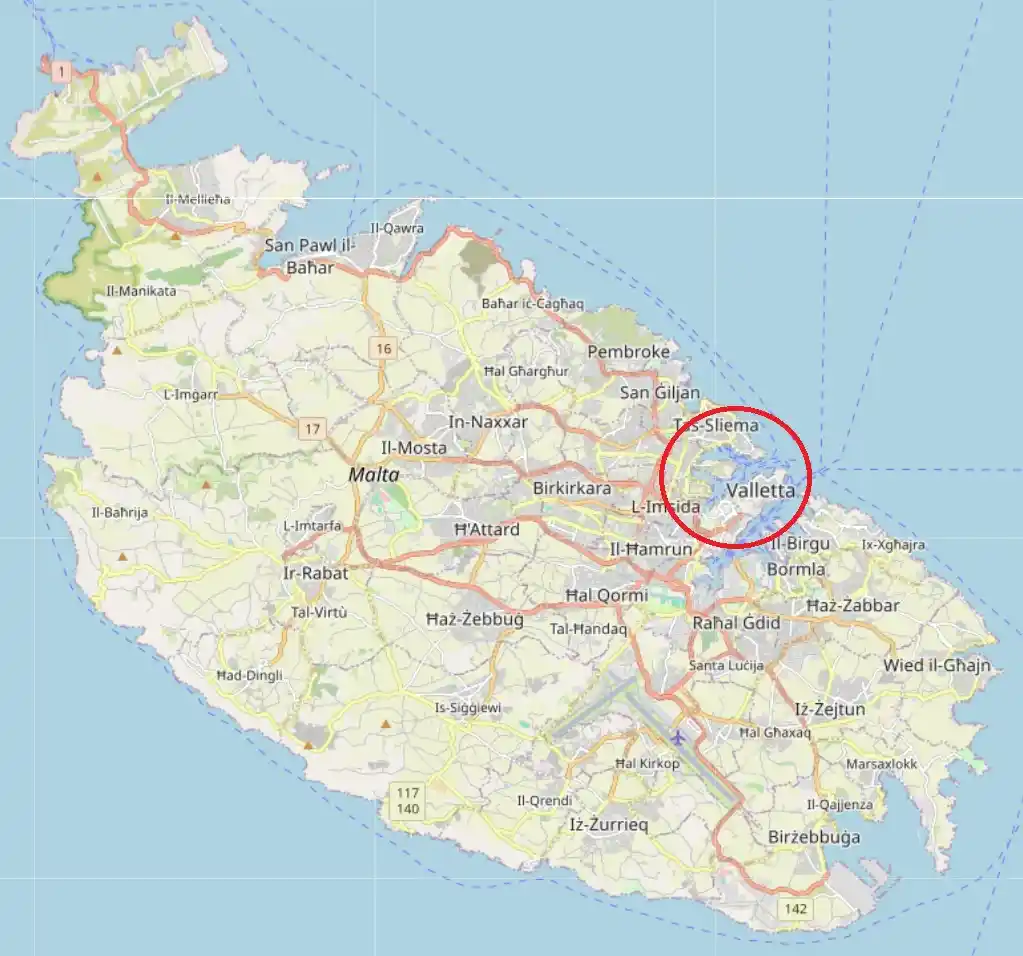
The first hour after landing matters more than people think. Malta International Airport is in the south of the island. The practical question is not whether a bus exists. It is whether you want to deal with it while tired, warm, and dragging bags.
The X4 runs direct to Valletta bus terminus. The X2 runs from the airport through Sliema and on to St Julian’s. Both cost a few euros and both work fine once you know the system. But on arrival day with luggage, a Bolt or eCabs ride is usually worth the €15–20 just to avoid starting the trip in a bad mood.
On mobile, swipe left to see full table details.
| Area | Bus | Ride-hail | What matters |
|---|---|---|---|
| Valletta | X4 direct, ~30 min | Easy to City Gate, not always easy to the property | The airport part may be fine. The last few hundred metres can still involve steps, slopes, and luggage drag. |
| Sliema | X2 direct, ~40 min | Usually the easiest door-to-door | For most first-timers, this is the least annoying arrival of the three. |
| St Julian’s | X2 continues through, ~45 min | Straightforward, especially to Spinola or Portomaso end | Easy enough by ride-hail. If your hotel is near Paceville, arrival noise can start early. |
Arrival-day advice: use Bolt, Uber, or eCabs. Malta buses make more sense once you are settled, not when you have just landed and are trying not to start the holiday in a bad mood.
Quick decision table
On mobile, swipe left to see full table details.
| You want… | Best pick | Why |
|---|---|---|
| The strongest old-Malta atmosphere | Valletta | Still the most dramatic of the three, and still the one that asks the most of you. |
| The easiest first trip | Sliema | Promenade, ferry, shops, flatter walking, and fewer silly little complications. |
| Nightlife, restaurants, and evening energy | St Julian’s | Paceville for clubs, Spinola Bay for a calmer but still lively dinner strip. |
| A proper apartment, central access, and easier parking | Gżira | The area between Sliema and St Julian’s that most people overlook. Often the best value in the central harbour area. |
| History, but not much patience for tight streets or hauling bags | Not Valletta | This is where brochure copy misleads people. Valletta is beautiful. It is not effortless. |
| A sandy beach outside the door | None of these | Choose them for central harbour life, not for sand. St George’s Bay in St Julian’s has a small beach, but it is not why people stay there. |
Valletta — the museum you sleep in
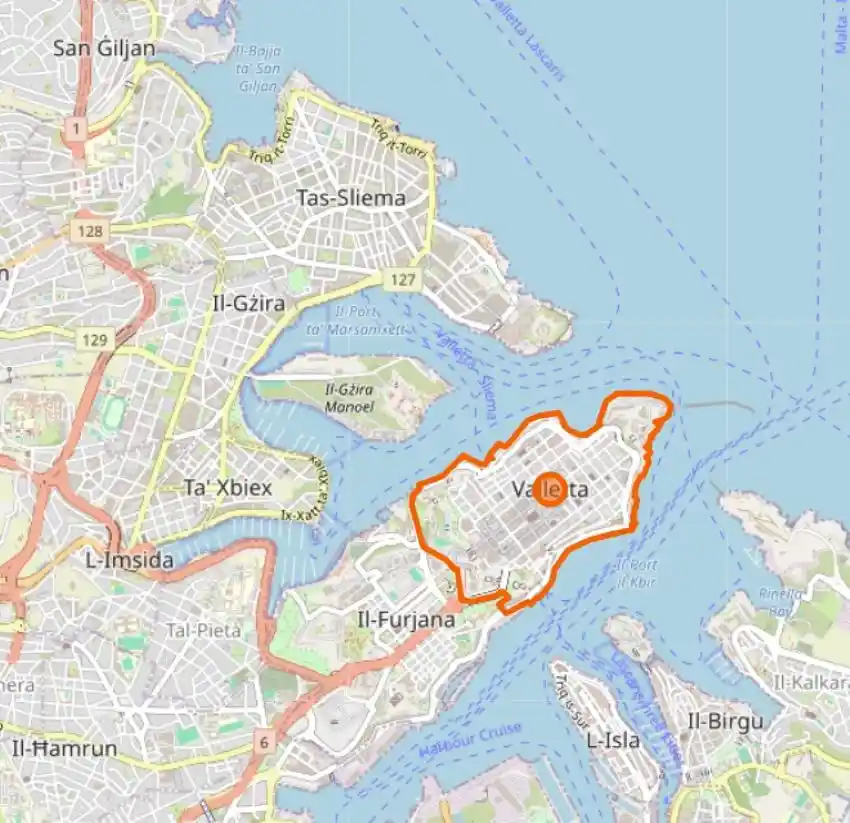
Valletta is a fortress. That means drama, views, old stone, churches, bastions — even a ten-minute walk feels like you are inside something rather than just walking through it. If you want the strongest first impression of Malta, this is it.
It also means the place was not designed for rolling suitcases, weak knees, strollers, or people who enjoy things being easy. By day three or four, the verticality can start to wear on you. Everything is an incline. Everything is limestone. And after a few days of it, even people who love the place start to notice their knees.
- Atmosphere: unmatched.
- Ease: worst of the four areas on this page.
- Main drawback: the stairs, slopes, and tightness are not background noise. They shape the stay.
- Mood: for some people it feels atmospheric; for others it starts to feel a bit closed-in after dark.
- Best in: spring and autumn.
Valletta highlights
The whole city is a UNESCO site smaller than most people expect — about 1.2 km by 700 metres. You could walk it end to end in twenty minutes, but you will not, because there is too much to stop for. A few worth knowing about:
- St John’s Co-Cathedral — the one building in Malta that makes everybody stop talking. Plain limestone outside, staggering Baroque inside. Caravaggio’s largest painting is here. Book ahead or arrive at opening. 📍
- Upper Barrakka Gardens — the best free view in Malta, looking out over the Grand Harbour and the Three Cities. The noon cannon firing is a reliable bit of drama. 📍
- Republic Street — the main pedestrian spine. Cafés, churches, the National Museum of Archaeology, the Grand Master’s Palace. This is where the day crowd flows.
For a proper walking route through the city, see the Valletta self-guided walking tour. For the museums specifically, there is a separate Valletta museums guide walked and ranked.
Sliema — the easy option
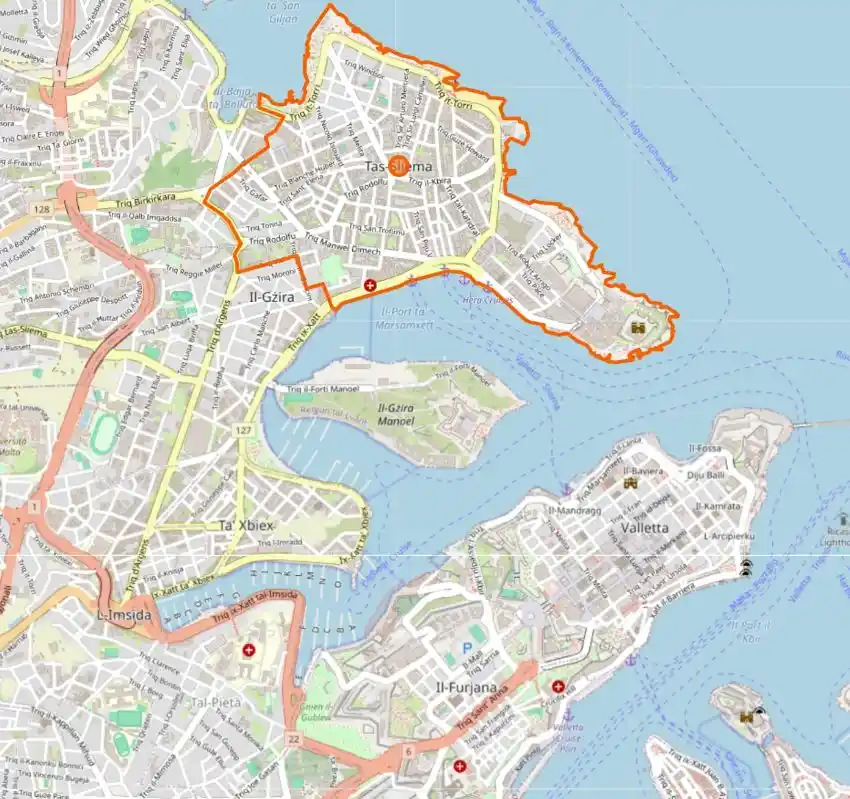
Sliema is where a lot of first-time visitors end up, and usually for good reason. Things work. The promenade is obvious, the ferry is useful, the supermarkets are where you need them to be, and you spend less time making annoying little decisions.
The weakness is not that Sliema is bad. It is that parts of it feel more practical than special. You stay in Sliema because it makes the trip easy. You do not usually stay there because you want to be overwhelmed by Maltese character.
- Best part: low-friction first trip.
- Good for: families, first-timers, ferry users, and people who want the simplest answer.
- Main drawback: some stretches feel generic by local standards.
Sliema highlights
- Sliema Promenade — about 2 km of flat waterfront walking from Qui-Si-Sana to St Julian’s. Popular for jogging, evening strolls, and the Valletta views across the harbour. 📍
- The Point Shopping Mall — the main shopping centre, over 50 shops across four levels plus a supermarket. At Tigné Point on the peninsula tip. 📍
- Exiles Beach — the most popular rocky swimming and sunbathing spot in Sliema. Sun loungers, a bar, and easy water access. Not sand, but usable. 📍
- Independence Gardens — a small waterfront park with a playground and a famous colony of street cats. Sunset from here is reliably good. 📍
- Peppi’s — right on the seafront at Exiles Bay. Big portions, sea views, reasonable prices. One of those places that fills up every evening for a reason. 📍
- Trattoria del Mare — tucked on The Strand with Valletta views across the water. Seafood-heavy, consistently well-reviewed, and worth booking ahead. 📍
St Julian’s — the one that depends most on where exactly you book
St Julian’s is two different places pretending to be one. Spinola Bay is a genuine waterfront quarter with good restaurants, a pretty harbour, and more than enough to fill an evening without trying. Paceville, a few minutes up the hill, is Malta’s main nightlife strip — loud, messy, packed on weekends, and not trying to be charming.
The mistake most people make is booking “St Julian’s” without realising how much the experience depends on which end they land in. Near Spinola or Balluta Bay, the feel is lively but manageable. Near Paceville, especially on a weekend, the noise starts after midnight and does not always stop when you want it to.
There is also the Portomaso end — newer, higher-end, quieter, and more resort-like. It works well for people who want modern hotels and marina-side restaurants but do not care much about local character.
- Best part: the restaurant and evening scene, especially around Spinola Bay.
- Good for: couples, groups, people who want evening energy without having to leave the area.
- Main drawback: if you book too close to Paceville without knowing what you are getting, you will not enjoy the surprise.
Paceville is not all of St Julian’s. The noisy club strip is a small part of the area. Spinola Bay and Balluta Bay are a different experience entirely — lively without being chaotic.
St Julian’s highlights
- Spinola Bay — the pretty harbour with coloured fishing boats, waterfront restaurants, and a calmer evening feel than anything in Paceville. This is where most people actually want to be. 📍
- Balluta Bay — small sandy patch with a neo-Gothic church behind it. A quieter alternative to St George’s Bay, especially outside summer. 📍
- St George’s Bay — the only proper sandy beach near any of these four areas. Small, gets crowded in summer, and the sand is coarse, but it is more than Sliema or Valletta can offer. 📍
- Portomaso Marina — the upscale end. Luxury yachts, waterfront restaurants, and the Portomaso Tower. Quieter and more polished than the rest of St Julian’s. 📍
- Paceville — Malta’s nightlife capital. Clubs, bars, fast food, and chaos from about midnight onward on weekends. Not for everyone, but the people it is for already know. 📍
- Hugo’s Lounge — cocktails, Asian fusion food, and a rooftop with views over St Julian’s Bay. Popular with couples and groups who want a more polished evening than the Paceville strip. 📍
- Havana Club — one of the biggest clubs in Paceville. Hip-hop and R&B in one room, Latin in the other. Free entry most nights. This is the loud end of St Julian’s. 📍
- Sky Club — another big Paceville venue, more EDM and house, with international DJs on rotation. Smart casual dress code enforced. 📍
The area most guides miss: Gżira
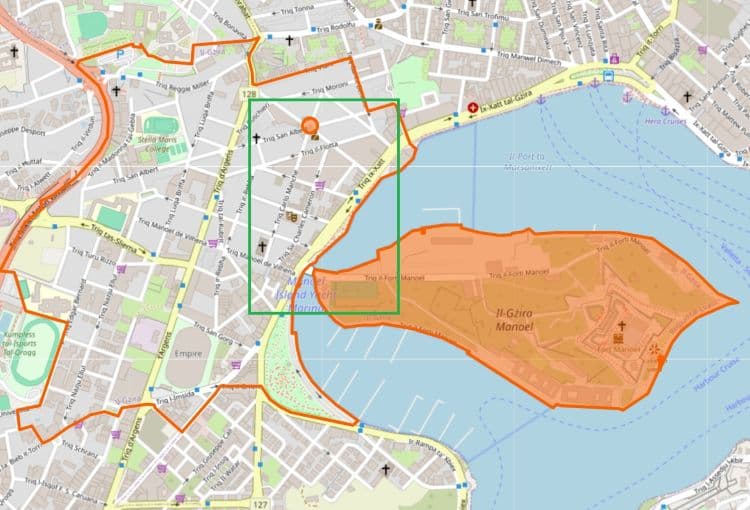
Gżira sits between Sliema and St Julian’s on the harbour side, and most guides either skip it entirely or dismiss it as “budget Sliema.” That is lazy, and usually wrong.
In practice, Gżira and Sliema are one continuous harbour corridor. Gżira often gives you the better deal: more space, easier parking, better apartment odds, and still very easy access to the same waterfront that people book Sliema for. The Sliema ferry is walkable. St Julian’s restaurants are walkable. And you are paying less for most of it.
The point many people miss is that not every good Gżira stay has to be on the seafront itself. Some of the nicest apartment stays are just behind the front on quieter streets. You can be under two minutes from the water without actually sleeping on the busiest road.
On Gżira: no, it is not one giant construction site. Parts of it are clearly improving and being cleaned up. That is real. But it is still a street-by-street booking area. One block can feel pleasantly local and tucked away. The next can feel too exposed, too noisy, or just a bit unfinished.
- Check the exact property in satellite view.
- Read recent reviews for the word noise, not just the score.
- If possible, stay between the Parish Church and the seafront, or just behind the front rather than deep inland.
- The sweet spot is often close enough to smell the sea, but one block back so you are not sleeping on the busiest road.
Gżira highlights
- Manoel Island — connected to Gżira by a short causeway. Fort Manoel (Knights-era, used as a Game of Thrones filming location) is being restored, and the island itself is one of the best spots in Malta for sunset views of Valletta. Quiet, slightly overgrown, nothing like The Strand. 📍
- Fort Manoel — not always open inside, but the walk around the exterior and the views from the island make it worth the detour. 📍
- Gżira waterfront — the promenade runs along The Strand with harbour views across to Valletta. Less polished than Sliema’s promenade, but more local and less crowded.
- Rock swimming spots — between Gżira and the Manoel Island causeway there are flat rock areas where locals swim. Not set up for tourists, but usable if you are comfortable with rocky entry.
- MedAsia Fusion Lounge — on The Strand at the Gżira/Sliema border. Asian fusion, harbour views, cocktails. The all-you-can-eat sushi Monday is well known locally. The “Mad Asia” strip around here has a different feel from the rest of the waterfront — more evening-oriented, a bit louder, and popular with a younger crowd. 📍
If you are comparing apartment-style stays rather than hotels, the next useful reads are how to choose a holiday rental in Malta and Airbnb alternatives in Malta.
One useful rule: in Gżira, one block makes a bigger difference than people expect. Near the front or just behind it can feel excellent. Too far inland and the reason for staying there starts to weaken.
A note on our Gżira property
ManicMalta is sponsored by an Airbnb in Gżira. It is not on the noisy seafront strip itself. It sits next to a church in a quieter, more quaint pocket less than two minutes on foot from the front. For a lot of people that is the better trade: central without being overexposed.
There are seafront hotels in Gżira too. This is simply a different type of stay.
Why Gżira connects to everything
The reason Gżira keeps appearing on this page — despite not being one of the three names people search for — is that it quietly plugs into everything the other three areas offer. You are not choosing Gżira instead of the Sliema ferry, or St Julian’s nightlife, or Valletta day trips. You are choosing Gżira and getting easy access to all of them.
- Valletta ferry: the Sliema–Valletta ferry departs from the Sliema waterfront, about a five-minute walk from most of central Gżira. It runs every half hour, costs a few euros return, and takes five minutes across the harbour. Faster and better than any bus for getting to Valletta. 📍
- Buses: Gżira sits on the same coastal corridor as Sliema and St Julian’s. Routes running along The Strand connect all three areas, and you can pick up services toward Valletta bus terminus, the north, and the airport without needing to change. The X2 airport bus passes through.
- Harbour tours: Captain Morgan harbour cruises and similar operators depart from the Sliema waterfront — the same stretch that is walkable from Gżira. About 90 minutes around both harbours, good views of Valletta, the Three Cities, and Fort Ricasoli. 📍
- Comino and Blue Lagoon trips: most day-trip boats to Comino depart from the same Sliema ferries area. You walk down the promenade, board the boat, and you are on the water. No need to bus to a ferry terminal in the north of the island.
- Pietà Creek Marina: just south of Gżira, the Creek Marina and the Msida Yacht Marina are a short walk along the harbour. Quieter, good for a morning walk, and a reminder that the harbour corridor extends further than most visitors realise. 📍 📍
- St Julian’s on foot: from central Gżira to Spinola Bay is about a 15–20 minute walk along the waterfront. For Paceville, add another five. You do not need a bus or a taxi to get to dinner or a night out.
The point is not that Gżira is better than staying in Sliema or St Julian’s. It is that you do not lose access to their infrastructure by staying between them — and you often gain value, space, and parking in the trade.
Day trips from each base
Malta is small enough that you can day-trip almost anywhere from almost anywhere. But “possible” and “annoying” are not the same thing, and the base you pick does change how smooth certain day trips feel.
Gozo: getting to the Gozo ferry at Ċirkewwa in the north takes about an hour by bus from Valletta (direct), longer from Sliema or St Julian’s because you usually change at Valletta terminus first. If you want to skip the bus entirely, organised boat trips to Gozo and Comino leave from the Sliema waterfront — walkable from Gżira — and handle the logistics for you. Not cheaper, but less hassle.
Comino and the Blue Lagoon: most of the popular boat trips leave from Sliema. If you are staying in Sliema or Gżira you can walk to the departure point. From Valletta or St Julian’s you would need a bus, taxi, or short ferry first. Not a big deal, but it adds twenty minutes and a bit of planning on a day when you probably just want to get on a boat.
The Three Cities (Birgu, Senglea, Cospicua): easiest from Valletta by far. There is a cheap harbour ferry that takes a few minutes and drops you right in Birgu. From Sliema or Gżira you can take the Sliema–Valletta ferry first and then walk across to the Three Cities ferry — two boats, but both are short. From St Julian’s it is a bus or taxi to either ferry point.
Mdina and Rabat: bus from Valletta terminus is the standard route, about 25 minutes. From Sliema, Gżira, or St Julian’s you either bus to Valletta first and change, or take a direct ride-hail for about €15. Mdina is one of those half-day trips that works from any base — the difference is just whether you change buses once or not.
Marsaxlokk (the fishing village Sunday market): bus from Valletta is the cleanest option. From the Sliema side it usually means a change at Valletta terminus. A Bolt from anywhere on the harbour corridor costs roughly €10–12 and saves you the transfer.
None of this should put you off any base. The island is 27 km long. But if your trip is mostly about day-tripping by bus, Valletta’s terminus gives you the simplest connections. If you are happy using ride-hail apps for the longer trips, it barely matters where you sleep. For a full breakdown of what is reachable from the Sliema/Gżira corridor, see day trips from Sliema and Gżira.
Transport and parking
On mobile, swipe left to see full table details.
| Need | Best base | Why |
|---|---|---|
| Using buses as the backbone of the trip | Valletta | The bus terminus is the island’s hub. Almost every route starts or ends here. |
| Quick ferry access to Valletta | Sliema or Gżira | The ferry is a five-minute walk from central Gżira and right on the Sliema waterfront. |
| Boat trips and harbour departures | Sliema or Gżira | Harbour cruises, Comino trips, and most day-trip boats leave from the Sliema waterfront. |
| Driving and parking practicality | Gżira | Still central, but easier to manage by car than Sliema, St Julian’s, or Valletta. |
| Walking to nightlife | St Julian’s | Already there. No taxi maths needed. |
| Late return after dinner or drinks | Any of them | At that point, get a ride and stop pretending the bus is somehow the noble option. |
Season and timing
- Spring: probably the best overall window for all of them, especially Valletta.
- Summer: Sliema, Gżira, and St Julian’s are easier in the heat because the waterfront opens things up. Valletta still looks good, but feels heavier. St Julian’s gets noticeably busier and louder.
- Autumn: almost as good as spring, often with slightly better value.
- Winter: mild by northern European standards, but Valletta becomes the least forgiving when things get wet and slippery.
Mobility and accessibility
If mobility matters, Valletta is the hardest choice. That includes weak knees, walking aids, and strollers. Sliema, Gżira, and the flatter parts of St Julian’s are all much easier on flat ground and much less likely to turn an ordinary outing into a small mission.
📷 IMAGE PLACEHOLDER
Suggested alt text: Sliema promenade showing broad walking path, waterfront cafés, and harbour views toward Valletta, Malta
Food, evenings, and supermarkets
On mobile, swipe left to see full table details.
| Area | Groceries | Evening feel | Overall note |
|---|---|---|---|
| Valletta | Doable, but not the easiest for practical self-catering | Atmospheric, romantic, quieter in stretches after the day crowd thins out | Better for eating out than for running life efficiently. |
| Sliema | The easiest all-round answer | Busy but manageable, with plenty of options | This is the area that saves you thinking. |
| St Julian’s | Fine around Spinola, thinner near Paceville | The strongest evening scene of the four, from casual Spinola dinners to full Paceville chaos | Best for eating out. Self-catering is more of a Sliema or Gżira advantage. |
| Gżira | Good enough locally, with Sliema close by | Mixed, lived-in, often better value than people expect | Good if you like your stay to feel slightly less packaged. |
Swimming and seaside
None of these areas gives you a proper sandy beach holiday. You pick them for harbour life and day-trip access, not for sand.
- Sliema: easiest day-to-day waterfront life and easiest rocky swimming setup.
- St Julian’s: St George’s Bay has a small sandy beach — the closest thing to sand in this part of Malta. It is not a beach resort, but it is more than Sliema or Valletta can offer.
- Valletta: great views, very weak case for convenient daily swimming.
- Gżira / Manoel Island: good views, some local swimming off the rocks, but not the obvious choice for children or cautious swimmers.
- If sand matters: treat it as a day-trip question, not a base question.
Price and value
- Valletta: you are paying for setting, stone, and atmosphere more than ease or space.
- Sliema: can be good value, but the range is wide and the exact property matters a lot.
- St Julian’s: tends to be the most expensive of the four areas, especially near Portomaso and Spinola Bay. You are paying for the restaurant and nightlife access.
- Gżira: often the best central-harbour math if you want a real apartment and do not want to pay full Sliema or St Julian’s prices for it.
Who each area suits
On mobile, swipe left to see full table details.
| Area | Best for | Less ideal for |
|---|---|---|
| Valletta | Couples, history lovers, shorter trips, people who want the strongest sense of place | Drivers, stroller-heavy trips, people who dislike enclosed streets or daily physical friction |
| Sliema | First-timers, families, convenience-led stays, people who want the easiest answer | Travellers chasing the strongest sense of old Malta or wanting serious nightlife |
| St Julian’s | Couples, groups, nightlife-seekers, restaurant lovers, weekend-trip visitors | Light sleepers near Paceville, families with young children, anyone who needs quiet after 11pm |
| Gżira | Apartment stays, longer trips, drivers, value seekers, people who want central without paying top Sliema or St Julian’s rates | Anyone who books blindly without checking the exact street |
FAQ
How do I get from Malta airport to Sliema, St Julian’s, or Valletta?
The X4 bus runs direct to Valletta (~30 min), and the X2 runs through Sliema to St Julian’s (~40–45 min). Both cost a few euros. But on arrival day with luggage, most people are happier using Bolt, Uber, or eCabs for €15–20. Valletta is the awkward one because easy drop-off does not always mean easy walk-in.
Is St Julian’s too noisy to stay in?
Only if you book near Paceville without knowing what you are getting. Spinola Bay, Balluta Bay, and the Portomaso end are all perfectly manageable. The noise problem is a Paceville problem, not a St Julian’s problem.
Is Gżira worth considering instead of Sliema?
For apartment value, easier parking, and a slightly less polished but often smarter base, yes, very often. For maximum ease and the cleanest first-time setup, Sliema still wins. The Sliema ferry, harbour tours, and Comino boat trips are all walkable from Gżira.
Can Valletta feel claustrophobic?
Yes, for some people. Others experience it as atmosphere. But the tight streets, dense stone, and vertical layout do make it feel more enclosed than Sliema, Gżira, or St Julian’s.
Which area is easiest if I have a car?
Gżira is usually the most practical compromise. Valletta is the most awkward by far — there is a congestion charge and very limited parking. Both Sliema and St Julian’s can be more frustrating than people expect.
Where should I stay in Gżira?
On the seafront side or just behind it, ideally between the Parish Church area and the waterfront. Too far inland and you lose much of the point of staying there.
Sliema or St Julian’s for a first trip?
Sliema is the safer, easier first-time pick. St Julian’s is better if evening restaurants and nightlife are a priority. If you want both and do not mind a slightly rougher-edged area, Gżira sits between the two and gives you walking access to both.
Final call
Want the strongest sense of old Malta and do not mind a bit of friction? Book Valletta.
Want the easiest first trip with the fewest logistical annoyances? Book Sliema.
Want restaurants, evening energy, and the liveliest scene? Book St Julian’s — near Spinola or Balluta, not on top of Paceville.
Want the smartest central value, easier parking, and a proper apartment between Sliema and St Julian’s? Book Gżira — near the front or just behind it, not too far inland.
Before going deeper, these may also help: where to stay in Malta, how to choose a holiday rental in Malta, and Airbnb alternatives in Malta.
Last updated: March 2026.
Stay in Gżira near the promenade
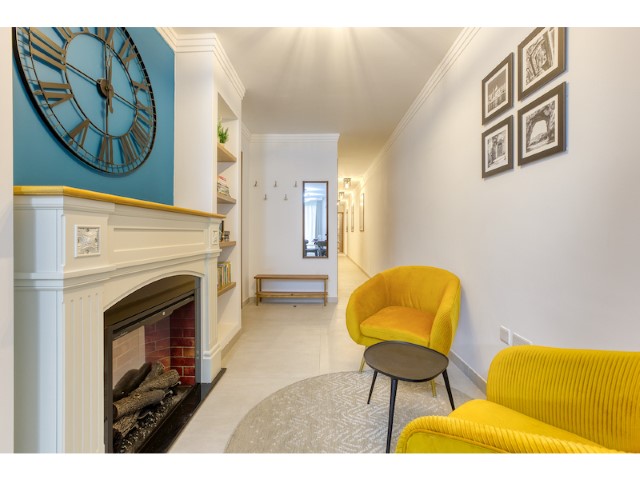
A designer 2-bedroom apartment in Gżira, close to the church, around 2 minutes from the promenade, and near Manoel Island.
View on Airbnb