

Malta History Timeline Explorer
Explore the rich history of Malta through this timeline. Each event includes expanded descriptions, lessons for modern readers, and verified references. Sources include ManicMalta.com, MaltaInfoGuide, BBC, Malta.com, Wikipedia, and Grokipedia. The content is factual and neutral, based on historical records.
Jump to:
Prehistoric
Ancient
Medieval
Knights
Colonial
Modern
Military
Cultural
Trade
Religious
Political
Showing 73 events
Prehistoric Era (18000 BC – 700 BC)
18000 BC – Sea Levels Lower Cultural
Sea level was 130 metres lower, connecting Malta to Sicily via a land bridge.
Geological changes influence human migration and settlement patterns.
12000 BC – Land Bridge Narrows Cultural
Sea level was about 100 metres below current levels, with the land bridge narrowing but still connecting Malta to Sicily.
Rising seas alter landscapes and isolation of regions.
c. 5900 BC – First Inhabitants Arrive Cultural
Mesolithic hunter-gatherers from Sicily inhabit Malta, marking the beginning of human settlement on the islands. DNA analysis shows origins from European and African Mediterranean regions; forests were cleared for farming, introducing mixed agriculture.
Human migration and adaptation to new environments highlight the importance of resilience and innovation in survival, relevant to modern climate refugees and sustainable farming practices.
5200 BC – Arrival of Stone Age Farmers Cultural
Stone Age farmers arrive on the islands, bringing agriculture and early settlement. Their tools and structures mark the beginning of long-term farming on Malta.
Agricultural transition shows how food systems reshape society and landscapes.
c. 4000-1500 BC – Hal Saflieni Hypogeum (Use Period) Cultural
The Hal Saflieni Hypogeum is constructed and used over centuries as an underground sanctuary and burial site, reflecting sophisticated ritual practice and engineering.
Subterranean architecture shows long-term planning and complex social organization.
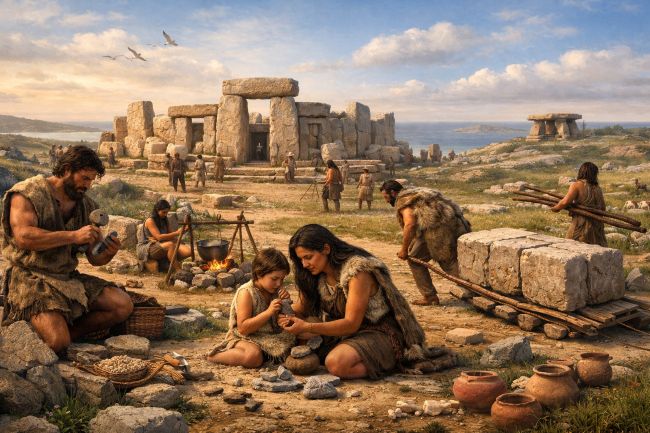
3600-2500 BC – Megalithic Temples Religious
Construction of megalithic temples such as Ggantija, Hagar Qim, Mnajdra and others, among the oldest freestanding stone structures in the world.
Shared beliefs and coordinated planning can unite communities for long-term cultural achievements.
ManicMalta | Wikipedia | Britannica | UNESCO | Grokipedia
c. 3600 BC – Ggantija Temples (Gozo) Cultural
On Gozo, the Ggantija Temples are built, among the oldest freestanding monuments in the world and part of the UNESCO-listed temple complex.
Preserving cultural heritage supports identity, education, and sustainable tourism.
c. 3600-3200 BC – Skorba Temple Construction Cultural
A small temple site at Zebbiegh provides key evidence for early Maltese prehistory, including a terracotta figurine and well-preserved remains.
Smaller sites can be as informative as famous monuments when evidence is well preserved.
3600-3000 BC – Ta Hagrat Temple Cultural
A preserved prehistoric temple in Mgarr with a reconstructed monumental doorway; part of Malta’s wider temple heritage.
Lesser-visited sites broaden understanding of prehistoric networks and community life.
2500-1500 BC – Bronze Age Period Cultural
Malta transitions into the Bronze Age with changing burial practices, fortified settlements, and evidence of metallurgy and evolving social structures.
Technological change requires adaptation, skills transfer, and resilience across generations.
1500-700 BC – Cart Ruts (Clapham Junction) Cultural
Mysterious parallel grooves carved into rock at Misrah Ghar il-Kbir (often called Clapham Junction), with uncertain origin and purpose.
Unresolved evidence invites careful investigation and humility about interpreting the past.
800 BC – Phoenician Arrival Trade
Phoenicians establish Malta as a trading post, linking the islands into Mediterranean maritime networks.
Strategic maritime hubs can accelerate exchange, innovation, and prosperity.
Ancient Era (800 BC – 533 AD)
400 BC – Carthaginian Control Military
Carthage ruled Malta, expanding its importance as a Mediterranean outpost and shaping local culture.
Foreign rule can transform regional dynamics and institutions over time.
255 BC – Roman Raid Military
Roman forces raided Malta during the First Punic War, causing severe disruption in the countryside.
Conflict has wide civilian impact, reinforcing the value of stable diplomacy.
218 BC – Roman Conquest Military
Malta becomes part of the Roman Republic during the Second Punic War, leading to integration into Roman systems and later municipal privileges.
Infrastructure and governance can be used to consolidate influence across regions.
60 AD – St. Paul Shipwreck Religious
Apostle Paul is traditionally associated with a shipwreck on Malta; the event is linked to Malta’s early Christian identity and later tradition around St. Publius.
Foundational narratives can shape identity for centuries and influence community institutions.
4th Century AD – Ta Bistra Catacombs Religious
Catacombs at Ta Bistra form a notable underground burial area associated with late Roman and early Christian practice in Malta.
Burial sites provide evidence for belief systems, community life, and social change.
395-870 AD – Byzantine Rule Military
Malta serves as a strategic naval outpost with fortifications and cultural influences from the Eastern Roman world.
Long-distance rule highlights the tension between local needs and imperial priorities.
454 AD – Vandal Occupation Military
Malta was briefly affected by Vandal power in the region before returning under Eastern Roman (Byzantine) influence.
After major empires weaken, peripheral regions often face rapid shifts in control.
464 AD – Goth Occupation Military
Malta experiences another period of instability during wider post-Roman power struggles in the Mediterranean.
Repeated turnover in authority can fragment governance and infrastructure.
533 AD – Byzantine Reconquest Military
Byzantine reconquest returns Malta to Eastern Roman control.
Strategic islands are frequently reclaimed to secure sea lanes and regional influence.
Medieval Era (870 AD – 1429 AD)
870 AD – Arab Rule Begins Military
Aghlabids take Malta from Byzantine control. Arabic language influence and agricultural innovations (including irrigation methods) shape the islands over time.
Cultural exchange can accompany political change, leaving long-lasting effects on language and agriculture.
1091 AD – Norman Conquest Military
Normans under Roger I take control, integrating Malta into the Kingdom of Sicily and accelerating re-Christianization over time.
Power transitions often reshape institutions; tolerance reduces long-term conflict in diverse societies.
1127 AD – Norman Control Consolidated Political
Norman control is consolidated under Roger II of Sicily; Christianity re-established as the dominant religion.
Consolidation of power can rapidly reshape legal and cultural norms.
1194-1266 AD – Swabian Rule Political
Malta and Sicily are ruled by the House of Hohenstaufen.
Dynastic shifts connect small territories to wider regional politics.
1224 AD – Removal of North African Communities Political
Under Swabian rule, remaining North African Muslim communities are removed from Malta and Sicily as part of wider regional policy shifts.
Population changes can reshape language, culture, and economic life for generations.
1266-1283 AD – Angevin Rule Political
Malta and Sicily are ruled by the Angevins.
Political instability can follow dynastic change and contested succession.
1282 AD – Sicilian Vespers Political
The War of the Sicilian Vespers begins, setting conditions for Aragonese control and wider regional realignment.
Uprisings can redirect political outcomes across entire regions.
1283 AD – Aragonese Rule Military
Malta and Sicily are ruled by the Crown of Aragon.
Naval power and alliances can determine long-term control of strategic islands.
1348 AD – Black Death Reaches Malta Cultural
The Black Death reaches Malta as part of the wider pandemic across Europe and the Mediterranean, causing major demographic and economic disruption.
Public health shocks can reshape economies, governance, and social structures for decades.
1397 AD – Universita (Council of Jurors) Established Political
The Universita (Council of Jurors) develops as a local governing institution, helping administer civic affairs and manage supplies during periods of changing rule.
Local institutions can provide continuity even when higher authority changes repeatedly.
1429 AD – Hafsid Siege Military
Hafsids from Tunisia attempt to capture Malta but fail, highlighting the islands’ strategic importance and defensive challenges.
Defensive resilience can deter threats and shape long-term security planning.
Knights Period (1530 AD – 1798 AD)
1530 AD – Knights of St. John Arrive Military
The Order of St. John is granted Malta by Charles V, beginning an era of fortification and defense amid Ottoman pressure.
Strategic alliances and infrastructure investment can transform a small territory’s regional role.
1530s AD – Corso and Captive Labor Economy Military
Under the Knights, privateering (corso) and ransom-based captivity become part of Mediterranean conflict and Malta’s economy; captives were held, ransomed, and sometimes forced into labor as part of the wider system.
Acknowledging difficult history improves credibility and supports balanced heritage interpretation.
1546 AD – Dragut Raid (Precursor Raids) Military
Ottoman corsair Dragut conducts raids in the region, part of escalating pressure and maritime conflict that foreshadows larger confrontations in the mid-16th century.
Smaller precursor events can signal larger strategic threats and shifting regional balance.
1551 AD – Mass Captivity on Gozo Military
An Ottoman raid on Gozo results in the mass capture of much of the population (often estimated at 5,000-7,000), with major social and demographic impact.
Raids underline the human cost of conflict and the long-term consequences for small communities.
1561 AD – Establishment of Inquisition Tribunal Religious
An Inquisition tribunal is established in Malta under papal authority, operating as a formal ecclesiastical court alongside local structures.
Institutional religious courts influenced social norms and legal practice for centuries.
1565 AD – Great Siege Military
Ottoman forces fail to capture Malta from the Knights and Maltese defenders after intense fighting, including the siege of Fort St Elmo.
Unity under pressure can determine outcomes even against larger forces.
1566 AD – Valletta Founded Cultural
After the siege, construction begins on Valletta, a fortified capital planned with Renaissance principles and strategic defenses.
Post-crisis rebuilding can create lasting urban legacies and strengthen resilience.
1614 AD – Wignacourt Aqueduct Completed Trade
The Wignacourt Aqueduct is completed, improving water supply to Valletta and supporting public health and urban growth.
Infrastructure investment can unlock long-term gains in health, productivity, and city development.
1639 AD – Lascaris Bando on Carnival Cultural
Grand Master Lascaris issues a bando restricting masking practices during Carnival, triggering unrest and leaving a lasting cultural idiom.
Social regulation can spark cultural pushback and become embedded in collective memory.
1693 AD – Great Earthquake Cultural
Powerful earthquake damages Mdina and other key sites; reconstruction reshapes architecture and strengthens communities.
Recovery after disasters can drive innovation and long-term improvements.
1723-1733 AD – Fort Manoel Built Military
A star fort (Fort Manoel) is built on Manoel Island under Grand Master Antonio Manoel de Vilhena, strengthening harbor defenses.
Fortification projects show how Malta repeatedly adapted to strategic security pressures.
1732 AD – Teatru Manoel Opens Cultural
Teatru Manoel opens as one of Europe’s oldest working theaters, becoming a long-term cultural landmark.
Cultural institutions create continuity and identity across political change.
1798 AD – French Occupation Military
Napoleon captures Malta en route to Egypt, ending the Knights’ rule and introducing rapid reforms, followed by local resistance and blockade.
Fast reforms can modernize systems but also trigger backlash if legitimacy and local consent are weak.
ManicMalta | Wikipedia | BBC | Grokipedia
Colonial Era (1798 AD – 1964 AD)
1798-1800 AD – Blockade of Three Cities Military
Maltese forces blockade French-held positions in the harbor area; the episode ends with French surrender and the beginning of British influence.
Local resistance combined with external alliances can reconfigure political outcomes.
1800 AD – British Protectorate Political
Malta becomes a British protectorate after French surrender, leading to long-term British rule and major strategic naval use.
Alliances shift with strategic needs, changing economic and political trajectories.
1814 AD – Treaty of Paris Political
Malta is formally confirmed as part of the British Empire, reinforcing its role as a Mediterranean naval and trade hub.
Treaties formalize power shifts and can reshape strategic trade routes.
1849 AD – First Constitution Granted Political
Malta receives a constitution establishing a form of governance under British administration.
Constitutional steps often come in phases, reflecting negotiation between local demands and imperial control.
1869 AD – Suez Canal Opens Trade
The Suez Canal opens, increasing Mediterranean shipping and reinforcing Malta’s strategic value along major maritime routes.
Major transport infrastructure can redirect trade flows and reshape regional economies.
1878-1886 AD – Fort Rinella Construction Military
A Victorian-era fort in Kalkara is built under British rule, housing one of the surviving Armstrong 100-ton guns.
Military technology and deterrence strategies evolve with shifting naval capabilities.
1883-1931 AD – Malta Railway Operates Trade
Malta’s railway operates between Valletta and Mdina/Rabat, shaping commuting and development until closure in 1931.
Transport links can expand opportunity but depend on long-term economic viability.
1901 AD – Naval Arsenal Explosion in Bormla Cultural
An explosion at the British naval arsenal in Bormla kills workers and causes widespread damage, highlighting industrial risks in colonial Malta.
Industrial safety practices become critical as infrastructure and heavy industry expand.
1902 AD – Hal Saflieni Hypogeum Discovered Cultural
Discovered during construction works, the Hypogeum becomes one of Malta’s most significant prehistoric sites and a UNESCO World Heritage Site.
Chance discoveries can transform historical knowledge and require careful long-term stewardship.
1914-1918 AD – WWI Nurse of the Mediterranean Cultural
During World War I, Malta treats large numbers of Allied sick and wounded (often cited as more than 135,000), earning the nickname Nurse of the Mediterranean.
Medical logistics and care capacity become decisive national contributions during major conflicts.
1919 AD – Sette Giugno Unrest Political
Protests over economic hardship and bread prices escalate; several people are killed, and the episode becomes a milestone in Malta’s political development.
Economic pressure can drive political reform and reshape legitimacy.
1921 AD – Self-Government Constitution Political
Malta receives a constitution granting self-government with an elected legislature, shaping modern political institutions.
Institutional design can balance autonomy with external strategic interests.
1934 AD – Maltese Recognized as Official Language Cultural
Maltese is recognized as an official language alongside English, marking a major milestone in national identity and administration.
Language policy can influence education, law, and cultural continuity.
1940-1943 AD – WWII Siege Military
Malta withstands sustained Axis bombing as a strategic Allied base; the population endures severe hardship during the siege.
Civilian endurance and logistics can be as decisive as battlefield outcomes.
1942 AD – Operation Pedestal and SS Ohio Arrival Military
A critical convoy brings supplies; the tanker Ohio is towed into Grand Harbour, delivering fuel that helps sustain Malta’s defense.
Supply chains can decide the outcome of sieges and prolonged crises.
1942 AD – George Cross Award Cultural
King George VI awards the George Cross to Malta for collective bravery during World War II; the award appears on the national flag.
Recognition of collective courage can strengthen morale and national identity.
1964 AD – Independence Political
Malta gains independence from Britain, becoming a sovereign state; Innu Malti becomes the national anthem.
Self-determination strengthens national identity and supports stable institutions.
Modern Malta (1964 AD – Present)
1964 AD – Joins the United Nations Political
Malta joins the United Nations soon after independence, expanding its diplomatic presence and multilateral engagement.
International membership can amplify small states through rules-based cooperation and diplomacy.
1974 AD – Becomes Republic Political
Malta becomes a republic with a Maltese president while remaining within the Commonwealth.
Constitutional evolution can consolidate sovereignty and modern governance structures.
1979 AD – British Forces Leave Military
The last British military base closes, marking the end of foreign military presence and reinforcing full sovereignty.
Base closures can reshape national strategy and economic planning.
1987 AD – Neutrality Clause Added to the Constitution Political
Malta adds neutrality provisions to the Constitution (Article 1, Subarticle 3), shaping long-term foreign policy positioning.
Constitutional clauses can lock in strategic principles across political cycles.
2004 AD – Joins the European Union Trade
Malta joins the EU, expanding economic integration and policy participation across Europe.
Regional integration can increase opportunity for small states through market access and shared standards.
2007 AD – Joins the Schengen Area (Land and Sea Borders) Trade
Malta becomes part of the Schengen area, removing controls at land and sea borders for Schengen travel (with later expansion to air borders).
Policy integration can meaningfully reduce friction for travel, trade, and mobility.
2008 AD – Adopts the Euro Trade
The euro becomes Malta’s official currency, simplifying trade and travel within the eurozone.
Shared currency systems reduce transaction friction but require strong fiscal coordination.
2011 AD – Divorce Legalized Political
A referendum leads to legal divorce in Malta, updating civil law in a society with strong religious traditions.
Democratic referendums can help societies update civil frameworks while maintaining social cohesion.
2017 AD – EU Council Presidency Political
Malta holds the rotating Presidency of the Council of the EU, helping set agendas across multiple policy areas.
Small states can lead effectively in multilateral institutions through preparation and coalition-building.
2018 AD – Valletta European Capital of Culture Cultural
Valletta is designated European Capital of Culture, hosting events that promote heritage, arts, and tourism.
Cultural programming can diversify the economy and strengthen identity through creative industries.
2020 AD – COVID-19 Arrives Political
Malta reports early COVID-19 cases and implements public health measures affecting travel, tourism, and daily life.
Public health resilience depends on clear communication, preparedness, and adaptive policy.
Stay in Gżira near the promenade
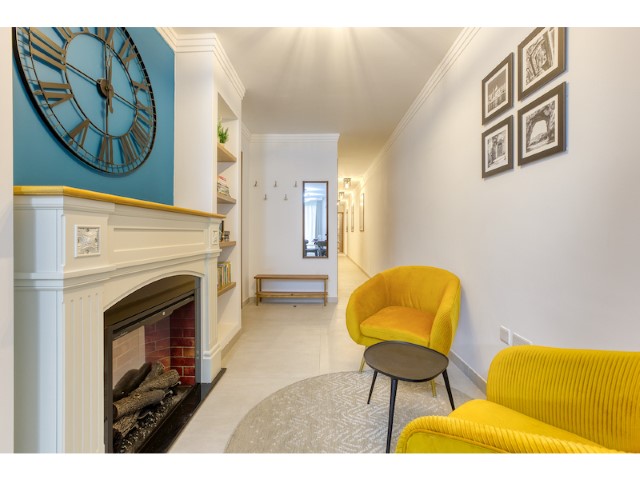
A designer 2-bedroom apartment in Gżira, close to the church, around 2 minutes from the promenade, and near Manoel Island.
View on Airbnb