
Disclaimer: This series is an educational commentary on the thinking systems developed by Dr. Edward de Bono. The terms “Six Thinking Hats,” “PMI,” and other specific tool names are the intellectual property of the de Bono Group. This content is not created by, affiliated with, or endorsed by the official de Bono organization. Its purpose is to explore the application of these publicly discussed ideas in a modern context. For official training, please consult the de Bono Group.
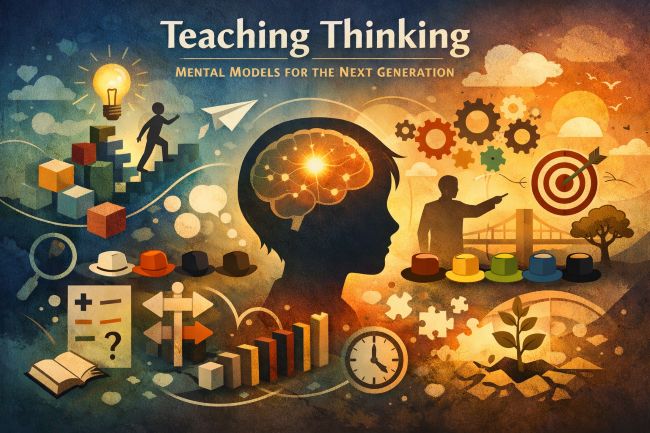
After exploring 17 of Dr. Edward de Bono’s foundational thinking tools, we’ve arrived at the final, most critical piece of the puzzle. This is Part 18, the capstone of the Maltese Mental Models series. Having built the toolkit, we now turn to the ultimate question: How do we pass these powerful mental models to the next generation?
This is the ultimate test of any thinking system—can you teach it to others? Edward de Bono spent his life not just developing thinking tools, but creating ways to transfer them. As the capstone to our ‘Maltese Mental Models’ series, we honor Malta’s most famous intellectual export by examining how to pass his powerful thinking tools to the next generation.
🌍 Why Teaching Thinking Matters More Than Ever
We’re raising children in an age of infinite information and instant answers. As we discussed in our introduction, Mental Models in the AI Age, this is the central challenge of our time. AI can solve their homework, social media shapes their opinions, and algorithms decide what they see. The core thinking skills we’ve detailed in this series—from the balanced perspective of PMI to the creative expansion of APC—are the essential human antidote.
| Traditional Emphasis | Modern Needs | The Gap |
|---|---|---|
| Memorize facts | Evaluate information | 🔍 Critical thinking deficit |
| Follow procedures | Create solutions | 💡 Innovation deficit |
| Avoid mistakes | Learn from failure | 🚀 Growth mindset deficit |
| Compete individually | Collaborate effectively | 🤝 Cooperation deficit |
| Accept authority | Question constructively | 🎯 Agency deficit |
De Bono’s tools, as outlined in books like Six Thinking Hats and Teach Your Child How to Think, bridge these gaps. These tools align with established cognitive science principles—PMI develops metacognitive evaluation, OPV builds Theory of Mind, and Six Hats prevents cognitive fixation in group decisions. Research consistently shows that children who develop these metacognitive and perspective-taking abilities perform better academically and socially. But how do we teach them effectively? Through decades of classroom experience worldwide, clear principles have emerged.
🎭 The Teacher’s Mindset: Be a Guide, Not a Guru
Before diving into tools and techniques, let’s establish the right mindset for teaching thinking:
- Curiosity over Correctness: Your goal isn’t to get them to the “right” answer, but to explore the thinking process. Ask “What’s another way to look at this?” more than “Is that correct?”
- Patience over Pace: True thinking takes time. Let them struggle a bit—the “stuck” phase is where learning happens. Resist the urge to jump in with the solution.
- Celebrate the Process, Not Just the Result: When a child uses a tool, even imperfectly, praise the effort. “I love how you used OPV to think about your friend’s feelings!” is more powerful than “You solved the problem.”
In my experience, this mindset shift is what separates effective thinking teachers from those who simply explain concepts. It’s about facilitating discovery, not delivering information.
🎓 The Four Pillars of Teaching Thinking
These four pillars inform a progressive curriculum, starting with the most tangible tools and gradually building toward more complex systems.
Pillar 1: Make It Tangible
Abstract concepts need concrete forms. De Bono understood this, which is why his tools have memorable acronyms and simple processes.
| Instead of… | Teach… | Through… |
|---|---|---|
| “Consider different perspectives” | OPV | Role-playing exercises |
| “Think about pros and cons” | PMI | Three-column lists |
| “Be creative” | PO | Specific provocations |
| “Plan ahead” | C&S | Timeline mapping |
Pillar 2: Practice Before Theory
Children (and adults) learn thinking by doing, not by studying. Introduce tools through activities, explain principles after.
The Cookie Problem Exercise
Setup: “We have 10 cookies and 12 children. What should we do?”
- Let them struggle with the problem briefly
- Introduce APC: “Let’s list all possible solutions”
- Watch creativity explode: cut cookies, make more, cookie lottery, sharing bites…
- Only then explain how APC works for any problem
Pillar 3: Embed in Real Situations
Thinking tools stick when they solve real problems. Use situations from their actual lives:
| Age Group | Real Situation | Thinking Tool | Goal |
|---|---|---|---|
| 5-8 years | Playground conflicts | OPV: “How does Sarah feel about the swing?” | Build empathy, reduce conflicts |
| 9-12 years | Project planning | AGO + FIP: “What’s our goal? What’s most important?” | Develop planning skills |
| 13-16 years | Social dynamics | Six Hats: “Let’s think about this party from all angles” | Navigate complex decisions |
| 17+ years | Future decisions | C&S + CAF: “What happens if you choose this path?” | Long-term thinking |
Pillar 4: Model, Don’t Preach
Children learn more from what we do than what we say. Use the tools yourself, visibly:
📚 The Progressive Curriculum
Foundation Level (Ages 5-10): The Basic Three
Start with the simplest, most immediately useful tools:
| Tool | Kid-Friendly Name | Simple Exercise |
|---|---|---|
| PMI | “Good-Bad-Interesting” | Evaluate a new rule or change |
| OPV | “In Their Shoes” | Why did the character in the story do that? |
| APC | “What Else?” | Different ways to build with blocks |
Development Level (Ages 11-14): Adding Direction
Introduce planning and prioritization tools:
| Tool | Teen Context | Application |
|---|---|---|
| AGO | Project goals | Science fair preparation |
| FIP | Time management | Homework vs. activities balance |
| CAF | Decision complexity | Choosing electives or activities |
Advanced Level (Ages 15+): Creative and Systems Thinking
Add sophisticated tools for complex thinking:
- Six Thinking Hats: For group projects and discussions
- Lateral Thinking: For innovation challenges
- C&S: For major life decisions
- Water Logic: For understanding social dynamics
🎮 Games and Activities That Teach Thinking
The PMI Cookie Game (Ages 5+)
Materials: Any snack, PMI chart
Process: Before eating, do PMI on the snack. Make it silly—”Plus: tastes good, Minus: will be gone, Interesting: makes crumbs that look like mountains”
Learning: Automatic balanced thinking, observation skills
The OPV Theater (Ages 7+)
Setup: Simple conflict scenarios on cards
Process: Act out each person’s view of the situation. Switch roles.
Example: “Dog barks at night. Owner thinks: protecting house. Neighbor thinks: losing sleep.”
Learning: Perspective-taking becomes natural
The APC Challenge (Ages 8+)
Challenge: Everyday problems with creative solutions needed
| Problem | Goal: Find 10 Solutions |
|---|---|
| Rain at the picnic | Umbrellas, move inside, rain dance party, waterproof food… |
| Lost homework | Redo it, call friend, check photo backup, explain honestly… |
| Boring car ride | Games, audiobooks, window art, create songs… |
Six Hats Family Meeting (Ages 10+)
Process: Assign hat colors for discussing family decisions
- ⚪ White: What facts do we know?
- 🔴 Red: How does everyone feel?
- ⚫ Black: What could go wrong?
- 🟡 Yellow: What’s good about this?
- 🟢 Green: Any creative ideas?
- 🔵 Blue: What’s our decision process?
💡 Teaching Thinking in the AI Age
AI changes everything about teaching thinking. It’s not the enemy—it’s the reason these skills matter more than ever.
The AI-Thinking Partnership
| Thinking Tool | AI Application | Example Student Thought Process |
|---|---|---|
| CAF | Before prompting AI | “I need to use CAF for my essay on Roman architecture. My prompt: ‘Act as a historian. Generate an outline for an essay on Roman architecture, ensuring you consider: available building materials, local climate, social purpose (public vs. private), defensive needs, and economic costs.'” |
| PMI | Evaluate AI responses | “The AI gave me a great essay outline. PMI time. Plus: Well-structured with clear sections. Minus: Sounds generic, lacks specific examples from Pompeii. Interesting: Mentioned concrete innovation I hadn’t heard of—need to verify this.” |
| OPV | Check AI bias | “The AI’s answer focuses only on grand public buildings. Let me use OPV—what about the perspective of common citizens? What about slaves who built these structures? What viewpoints are missing?” |
| C&S | Think beyond AI’s answer | “The AI suggests this engineering solution worked well. But using C&S—what were the long-term consequences? Did this building method contribute to Rome’s later economic problems?” |
| APC | Generate alternatives to AI suggestions | “The AI gave me one thesis approach. What else could work? Maybe comparing Roman and Greek architecture? Or focusing on how climate shaped design? Let me generate 5 alternative angles.” |
The Human-AI Thinking Partnership
It’s crucial to understand what AI does well and where human thinking remains essential:
- AI excels at: White Hat thinking (facts and data), generating Green Hat ideas (creative alternatives)
- Humans excel at: Red Hat thinking (emotions, intuition), Black Hat thinking (critical evaluation, risk assessment), Blue Hat thinking (process management, big-picture synthesis)
- The partnership: Use AI as a research assistant and idea generator, but maintain human judgment for evaluation, emotional intelligence, and strategic decision-making
Teaching Critical AI Thinking
Exercise: The AI Double-Check
- Ask AI to solve a problem
- Apply PMI to its solution
- Use APC to find alternatives AI missed
- Apply C&S to think through consequences
- Create a better synthesis
This teaches students that AI is a tool, not an oracle. They learn to think with AI, not defer to it.
🔄 Skill Transfer: From Exercise to Life
A common challenge is ensuring skills learned in structured exercises transfer to real-world situations. Here’s how to bridge that gap:
The Transfer Strategy
- Start Structured: Use formal exercises like “The Cookie Problem”
- Bridge to Similar: Apply the same tool to a slightly different problem
- Prompt Recognition: “That was tricky. Is there one of our thinking tools that might have helped?”
- Celebrate Spontaneous Use: When they apply a tool unprompted, acknowledge it enthusiastically
Transfer Techniques by Age
| Age | Structured Exercise | Real-World Bridge | Transfer Prompt |
|---|---|---|---|
| 5-8 | PMI on a toy | PMI on bedtime | “Should we do our Good-Bad-Interesting on this?” |
| 9-12 | APC for puzzle | APC for homework problem | “Stuck? What would APC tell us to do?” |
| 13+ | Six Hats discussion | Friend group conflict | “Which hat would help us think about this differently?” |
The goal is to make tool use so natural that children reach for them automatically when facing challenges, without needing prompts.
🚀 Advanced Teaching Strategies
The Stealth Method
Building on our “Teacher’s Mindset” principle of being a guide rather than a guru, sometimes the best way to teach thinking is not to announce it:
| Situation | Stealth Application | Result |
|---|---|---|
| Teen complaining about teacher | “Hmm, I wonder why she assigned that…” | Natural OPV exploration |
| Child stuck on homework | “What else could we try?” | APC without naming it |
| Family arguing | “Let’s list what’s good about each idea” | PMI defuses tension |
The Thinking Journal
Encourage reflection and tool practice:
- Daily PMI: One thing from the day
- Weekly OPV: Understanding someone who frustrated them
- Monthly AGO: Setting and reviewing personal goals
- Problem Bank: Collecting situations where tools helped
Peer Teaching
The deepest learning comes from teaching others:
- Learn a tool together
- Child teaches it to sibling/friend
- Create their own examples
- Develop variations
⚠️ Common Teaching Mistakes
| Mistake | Why It Fails | Better Approach |
|---|---|---|
| Tool Overload | Teaching all tools at once | Master one before adding another |
| Forcing It | “We must use PMI now!” | Wait for natural opportunities |
| Perfect Execution | Correcting every attempt | Celebrate trying, refine gently |
| Adult Problems | Using examples they can’t relate to | Start with their world |
| Making It Academic | Teaching as school subject | Integrate into daily life |
⚖️ Potential Pitfalls and Criticisms
To teach these tools effectively, we must understand their limitations and address common concerns:
“Is it too simplistic?”
The Concern: Some educators worry that reducing complex thinking to acronyms oversimplifies cognition.
The Response: The simplicity is a feature, not a bug. It makes the tools teachable and memorable. These tools don’t claim to capture all nuances of thought but provide accessible starting points that build thinking habits. Research shows that simple frameworks, when internalized, can scaffold more complex cognitive processes.
“Where’s the clinical data?”
The Concern: Critics note that de Bono’s tools aren’t always framed in academic cognitive science terminology.
The Response: While not always couched in academic jargon, the principles align with well-established cognitive research. PMI develops metacognitive evaluation skills, OPV builds Theory of Mind, and Six Hats implements parallel processing to prevent cognitive fixation—all concepts validated by decades of psychological research.
“Does it create rigid thinking?”
The Concern: Could teaching structured tools make thinking more rigid?
The Response: This is a legitimate risk if tools are taught as rigid checklists. That’s why this guide emphasizes the “Guide, Not a Guru” mindset and the “Stealth Method.” When taught properly, the tools become flexible scaffolds that eventually disappear into intuitive thinking patterns. The goal is fluency, not formulaic application.
“The Illusion of Mastery”
The Concern: Children might learn the acronyms without truly changing their thinking processes.
The Response: This is why we emphasize practice over theory and real-world application. True mastery shows in spontaneous use, not in ability to recite definitions. Look for children who naturally say “Let me think about this differently” rather than those who can perfectly explain what APC means.
🌟 Success Stories: Thinking Tools in Action
These stories illustrate a key principle: when children internalize a thinking framework, they begin solving problems we never anticipated.
The Bullying Solution
A teacher shared this story: One of her students, a 10-year-old named Leo, was being bullied. Instead of retaliating or withdrawing, Leo used the OPV tool they’d practiced in class. He realized the bully seemed scared of being left out of a new friend group. Using APC, Leo brainstormed ways to include the bully in activities. Within weeks, the bullying stopped. “What struck me,” the teacher noted, “was that Leo never asked for help. He just applied the tools we’d practiced.”
The Science Fair Winner
Maya, a 13-year-old student, transformed her approach to the science fair using the thinking toolkit:
- AGO: She defined clear, measurable objectives rather than a vague “good project” goal
- CAF: She identified variables others overlooked, like time of day for plant measurements
- APC: She generated seven hypotheses before choosing the most testable one
- C&S: She considered implications of her findings for local agriculture
- PMI: She presented balanced results, including unexpected findings
Maya not only won but told her teacher: “The thinking process was more valuable than the prize. I use these tools for everything now.”
The Family Transformation
One parent wrote to share their experience: “We started using Six Hats for our weekly family meetings as a fun experiment. My teenager was skeptical at first, but something shifted. Instead of our usual arguments, we started genuinely solving problems together. My daughter said, ‘It’s weird—we still disagree sometimes, but now I understand why you think what you think.’ That understanding has changed everything.”
📊 Measuring Success
How do you know the teaching is working? Look for these signs:
| Age | Early Success | Developing Mastery | Advanced Application |
|---|---|---|---|
| 5-8 | Names tools correctly | Uses with prompting | Applies spontaneously |
| 9-12 | Follows tool steps | Adapts to situations | Teaches others |
| 13-16 | Chooses appropriate tools | Combines multiple tools | Creates variations |
| 17+ | Systematic application | Intuitive integration | Innovation with tools |
The Ultimate Test
You know you’ve succeeded when they stop thinking about the tools and just think better. The scaffolding becomes invisible, but the structure remains.
🎯 Your Teaching Toolkit: Quick Start Guide
Week 1: Foundation
- Introduce PMI through a fun decision
- Practice on 3 daily situations
- Make a PMI chart together
- Celebrate “interesting” findings
Month 1: Expansion
- Week 2: Add OPV for conflicts
- Week 3: Introduce APC for problems
- Week 4: Combine all three naturally
Ongoing: Integration
| Time | Activity | Tool Practice |
|---|---|---|
| Morning | Planning the day | AGO + FIP |
| Problems | Solving together | CAF + APC |
| Conflicts | Understanding | OPV + PMI |
| Decisions | Thinking ahead | C&S + AGO |
| Reflection | Learning from day | PMI + insights |
🌍 The Ripple Effect
I believe that when you teach a child to think, you don’t just change their life—you change the future. These tools ripple outward in ways we can’t fully predict:
- They teach their friends, creating thinking communities
- They raise children who think even more fluidly
- They solve problems we haven’t yet imagined
- They create a more thoughtful, empathetic world
Edward de Bono believed thinking could be taught like any skill. He was right. But more than that—thinking must be taught, especially now. In a world of infinite information, artificial intelligence, and complex global challenges, the ability to think clearly, creatively, and compassionately becomes humanity’s crucial advantage.
Your Mission, Should You Choose It
Pick one child in your life. Choose one tool—I recommend starting with PMI. Make it fun. Watch what happens.
In my experience, the transformation is remarkable. Children who learn these tools don’t just perform better academically; they navigate life with greater confidence, empathy, and creativity. They become not just problem-solvers, but problem-finders and solution-creators.
The tools in this series aren’t just intellectual exercises—they’re gifts you can give to the next generation. And perhaps that’s de Bono’s greatest legacy: not the tools themselves, but the generations of thinkers who will use them to build a better world.
📚 Complete Your Journey
Congratulations on completing the Maltese Mental Models series! You now have a comprehensive framework for clearer thinking. Revisit any tool by clicking on the links below.
| Foundation Tools: | PMI (Plus, Minus, Interesting), CAF (Consider All Factors), OPV (Other People’s Views) |
| Direction Tools: | AGO (Aims, Goals, Objectives), FIP (First Important Priorities), C&S (Consequences and Sequels) |
| Creative Tools: | APC (Alternatives, Possibilities, Choices), Lateral Thinking, PO (Provocative Operation) |
| Integration Tools: | Six Thinking Hats, DATT Framework, Water Logic |
| Advanced Tools: | Simplicity, Sur/petition, L Game Thinking |
| Series Overview: | Mental Models in the AI Age, Edward de Bono: The Man Who Taught the World to Think |
But the real toolkit isn’t the individual tools—it’s the thinking habits they create. Use them. Share them. Teach them. Let’s create a generation that doesn’t just consume information but transforms it into wisdom.
The future belongs to those who can think. Thanks to Edward de Bono, we know how to teach them.
Navigation: ← Previous: L Game Thinking | Series Hub: Mental Models in the AI Age
End of the Maltese Mental Models series • Teaching Edward de Bono’s thinking tools for the AI age
Stay in Gżira near the promenade

A designer 2-bedroom apartment in Gżira, close to the church, around 2 minutes from the promenade, and near Manoel Island.
View on Airbnb